
NVIDIA DGX Spark / GB10 price and feature comparison with NVIDIA DGX Station GB300
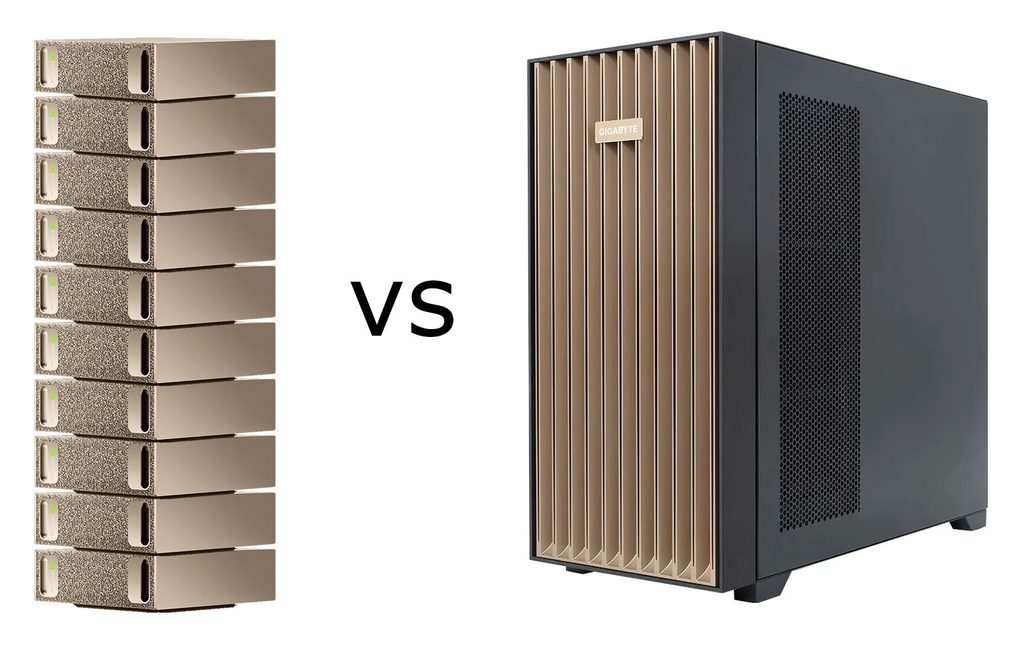
In this blogpost, we compare the DGX Spark and it’s price, features and performance with the DGX Station GB300.
Our image shows ten NVIDIA DGX Sparks which – stacked – are of a comparable height to one of the NVIDIA DGX Station GB300 systems.
The NVIDIA DGX Spark
The NVIDIA DGX Spark, or it’s OEM versions – the GB10 systems – are compact desktop supercomputers with the following features:
- NVIDIA GB10 Superchip (Grace Blackwell architecture)
- 20-Core ARM CPU (10 x Cortex-C925 + 10 Cortex-A725)
- 128 GB LPDDR5x RAM
- 273 GB/s memory bandwidth
- up to 1 PetaFLOP (sparse) performance at FP4 precision for LLM inference
- NVIDIA ConnectX-7 port – up to 200 GBit/s bandwidth for connecting two or more NVIDIA DGX Sparks
- 1 x 10 GbE network port
- WiFi 7 & Bluetooth 5.4 with Bluetooth LE
- 1 / 2 / 4 TB NVME.M2 drives (depending on OEM)
There are currently several versions available from NVIDIA and OEMs:
- NVIDIA DGX Spark (4 TB) also known as the DGX Spark Founders Edition
- Acer Veriton GN100 AI Mini Workstation ( up to 4 TB)
- ASUS Ascent GX10 (1 / 2 / 4 TB)
- Dell Pro Max with GB10 ( 1 / 2 / 4 TB )
- Gigabyte AI TOP ATOM ( 1 / 2 / 4 TB )
- HP ZGX Nano AI Station ( 2 / 4 TB )
- Lenovo ThinkStation PGX Small Form Factor Workstation ( 1 / 2 / 4 TB )
- msi EdgeXpert ( 1 / 4 TB )
How does the NVIDIA DGX Spark compare to the NVIDIA DGX Station GB300?
TL;DR: Typically, the DGX Station will be able to execute much bigger models at higher performance (token/s throughput speeds). For customers considering the DGX Station, the DGX Spark could give a first taste of the possibilities of local LLM inference, and also allow prototyping at a smaller scale.
The NVIDIA DGX Station is a much more powerful, and also more expensive machine, compared to the DGX Spark. In the tables below, we have compiled technical features, and some performance data to help you compare the two systems. Refer to our blog post for a vendor overview and more details about DGX Station systems.
Here is a comparison table for the technical features for DGX Spark vs DGX Station:
| system | NVIDIA DGX Spark GB10 | NVIDIA DGX Station GB300 |
| system architecture | GB10 (Grace Blackwell) | GB300 (Grace Blackwell) |
| CPU | 20-core ARM: 10 Cortex-X925 ( ARM ) 10 Cortex-A725 ( ARM ) | NVIDIA Grace ™ 72-core Neoverse V2 ( ARM ) |
| GPU | NVIDIA Blackwell | NVIDIA Blackwell Ultra |
| MIG | no | Multi-instance GPU for up to 7 MIGs |
| additional GPU | no | optional, one of: NVIDIA RTX PRO 6000 Workstation Edition RTX PRO 6000 Blackwell Max-Q Workstation Edition RTX PRO 4000 Blackwell SFF Edition RTX PRO 2000 Blackwell |
| RAM | 128 GB LPDDR5x unified RAM | 748 GB coherent memory, consisting of: 496 GB LPDDR5x 252 GB HBM3e |
| memory bandwidth | 273 GB/s for 128 GB LPDDR5x | 396 GB/s for 496 GB LPDDR5x 7.1 TB/s for 252 GB HBM3e |
| coherent memory link | N/A (single unified memory) | NVLink ®-C2C, 900 GB/s interconnect bandwidth |
| storage | single storage interface 1TB / 2TB / 4TB NVME.M2 options (*) | 2x M.2 PCIe 5.0 x4 NVMe (M-key 2280), from CPU, with software RAID 1 support 2x M.2 PCIe 6.0 x4 NVMe (M-key 2280), from ConnectX-8 typically populated with 4x 2TB SSDs – configurable (4TB – 32TB) additional storage extension possible via PCIe slots |
| PCIe slots | no | 1x PCIe Gen 5 x16 FHFL double-width, for GPUs 2x PCIe Gen 5 x8 (in x16) FHHL 1x M.2 PCIe 2.0 x1 slot (E-Key 2230)), for WiFi, from ConnectX-8 |
| I/O ports and connectors | 4x USB TypeC 1x HDMI 2.1a Up to 3x DisplayPort over USB-C (DP Alt Mode) | depending on OEM, for example: front: 1x USB 3.2 Gen2 port (Type-C) (5V Output) 2x USB 3.2 Gen1 ports (Type-A) 2x Audio jacks (Audio out/Mic) rear: 4x USB 3.2 Gen2 ports (Type-A, 10 Gbit/s) 1x microUSB port (USB-to-UART) 1x mini-DP (video port, 1920 x 1080 @ 60 Hz) 2x Wi-Fi antenna ports 3x Audio jacks (Audio in/Audio out/Mic) additional video interfaces depending on optional GPU (e.g. 4x miniDP) |
| Wi-Fi / Bluetooth | WiFi 7 Bluetooth 5.4 w/LE non-upgradeable | OEM-dependent absent on some machines upgradeable / configurable |
| Networking | ConnectX-7 Smart NIC @ 200 Gbps: 2x QSFP56 ports for linking two or more DGX Sparks 1x RJ-45 10 GbE LAN port | ConnectX-8 Smart NIC @ 800 Gbps: 2x QSFP112 ports for linking two or more DGX Stations (400 Gb/s per port) 1x RJ-45 10 GbE LAN port 1x RJ45 1GbE Dedicated BMC LAN port |
| Enterprise features | TBD | out-of-band telemetry via BMC Redfish API support NVIDIA Data Center GPU Manager visibility, monitoring, remote management capabilities hardware root of trust enterprise secure boot |
| system cooling | OEM dependent. passive active (with fan – HP) | closed loop liquid cooling system with fans (OEM-dependent) |
| chassis type | Small form factor (SFF) | Tower Workstation OEM-dependent: Rack-mountable (5U) |
| dimensions & weight | OEM dependent. NVIDIA DGX Spark: 150 mm (L) x 150 mm (W) x 50.5 mm (H) 1.2 kg (2.6 lbs) | OEM dependent. e.g. Gigabyte W775-V10-L01: 531 mm (L) x 245 mm (W) x 500.4 (H) 34.4 kg (75.8 lbs) |
| sound power level | OEM dependent. NVIDIA DGX Spark: 35 dB mean A-weighted sound power level in operating mode | TBD (louder, but still at office level – conversation possible at full load) |
| Power requirements | 240W external power supply (included): 140W TDP for GB10 SoC 100W for other system components (ConnectX-7, Wi-Fi, SSD, USB-C, etc) | 1600W integrated power supply unit (lower for Japan) |
(*) The 1TB and 2TB storage options are only available on the OEM (GB10) versions.
Here is a direct performance and price comparison of the DGX Spark vs the DGX Station:
| system | NVIDIA DGX Spark GB10 | NVIDIA DGX Station GB300 |
| FP4 tensor performance | 1 PFLOP (sparse) | 20 PFLOPS (sparse) 15 PFLOPS (dense) |
| FP8 | TBD | 10 PFLOPS (sparse) 5 PFLOPS (dense) |
| Tensor Cores | 5th Generation | TBD |
| RT Cores | 4th Generation | no |
| AI model support | up to 200 billion parameters up to 405 billion parameters for dual DGX Spark configuration (**) | up to 1 Trillion parameters up to 2 Trillion parameters for dual DGX Station configuration (**) |
| price excluding VAT (September 2026) | $4,800 (for 4 TB DGX Spark) | $101,000 (OEM and config dependent, as an exampleMSI XpertStation WS300 2x2TB no extra GPU) |
| price / sparse PFLOP | $4,800 / PFLOP | $5,050 / PFLOP |
| price / GB of RAM | $37.5 / GB (128 GB total) | $135.03 / GB (748 GB total) $400.79 / GB (if just for the 252 GB HBM3e) |
| W / sparse PFLOP (total system power) | 240 W | 80 W |
| system target audience | prosumers, SoHO businesses | teams, work groups, enterprise users |
(**) depends on the quantization
Why the NVIDIA DGX Station GB300 is a better choice for teams vs. DGX Sparks:
In pricing terms, PFLOP for PFLOP the DGX Station roughly matches the DGX Spark.
On top of that, the DGX Station offers much faster HBM3e RAM, better network connectivity, higher flexibility and extendibility of the system, enterprise management features.
Finally, it is much more energy efficient per PFLOP of compute power, which allows to lower the energy usage bill.
Further performance comparisons and figures:
Also see our blog post for the performance comparison between DGX Station GB300 and a 4x or 8x RTX Pro 6000 GPU Server for additional performance information for the DGX Station GB300 in different Floating Point / Integer compute precisions.
What are some other use cases of the DGX Spark in comparison with the DGX Station?
At pi3g, we primarily see the DGX Spark as an application-centric machine, for example as a local application server for infusing e-Mail applications with AI features.
It is also brilliant for other tasks which require smaller LLM models, or can run in a batch mode. For example, it is great for some agentic AI tasks, and small RAG systems.
The Blackwell architecture of the DGX Spark will support some light scientific computing tasks.
Another interesting use case for the DGX Spark is leveraging the high-speed QSFP56 ports, for example to connect to 5G network radios.
The DGX Spark is a good choice for prosumers, and small businesses.
In contrast, the DGX Station GB300 can serve as a powerful local inference server for a whole team, for data scientists fine-tuning models, or for higher-end scientific applications. It is the enterprise choice.
As of September 2026, the DGX Station GB300 is the most powerful purpose-designed desktop machine for AI inference tasks.
It can plug into normal office sockets, and operates at acceptable noise levels. It’s huge unified memory allows it to run bigger models without worrying about properly sharding them across several GPUs. It is the first system which brings HBM3e – high bandwidth memory – to the desktop.
The Grace Blackwell Ultra chip architecture is the same which is also used in more powerful B300 data center grade server systems. It particularly shines with high compute efficiency per Watt.
We see the DGX Station as a great choice for family offices, venture capitalists, software development teams, and all other teams dealing with sensitive documents and needing confidential local AI inference.
We help to advise you on your particular use case, and support you in choosing the right DGX Spark / DGX Station system:
 English
  Deutsch (Sie)