
Gigabyte W775-V10-L01: DGX Station GB300 Teardown
At ISC 2026 we got a Gigabyte W775-V10-L01 with its side panel off, and photographed it properly. It is one of the first deskside implementations of the NVIDIA DGX Station GB300 platform, and there is very little published photography of one opened up. Below are the verified specifications, what the interior actually looks like, and where Gigabyte’s build differs from Supermicro’s take on the same NVIDIA reference design.
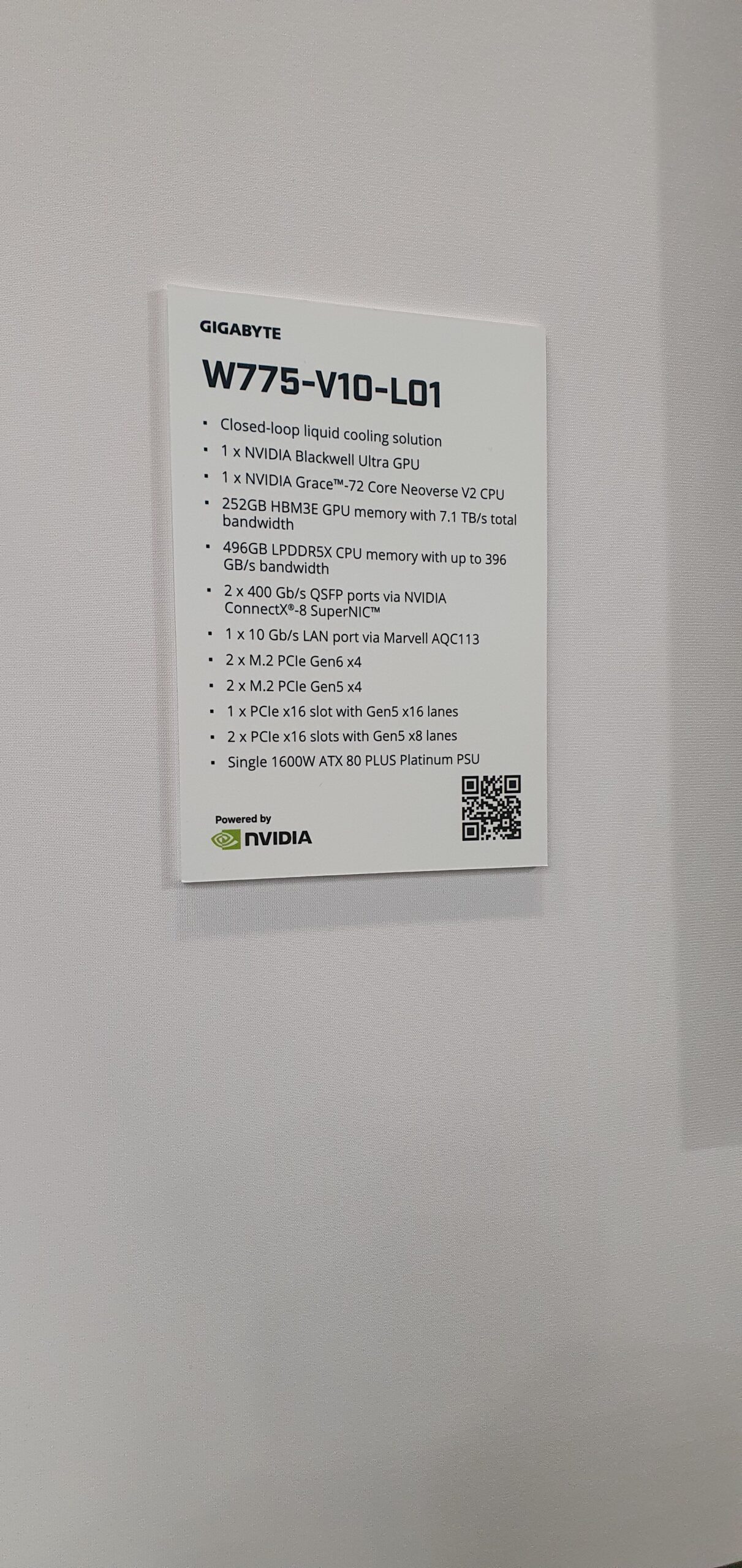
Every figure in the table below is transcribed from Gigabyte’s own specification placard photographed at the booth, and cross-checked against NVIDIA’s published DGX Station specification. Where Gigabyte claims something beyond the NVIDIA reference, we say so.
Gigabyte W775-V10-L01 specifications
| Component | Specification |
|---|---|
| Superchip | NVIDIA GB300 Grace Blackwell Ultra Desktop Superchip |
| GPU | 1 × NVIDIA Blackwell Ultra |
| CPU | 1 × NVIDIA Grace, 72-core Arm Neoverse V2 |
| Coherent memory | 748 GB total |
| GPU memory | 252 GB HBM3E, 7.1 TB/s |
| CPU memory | 496 GB LPDDR5X, up to 396 GB/s |
| CPU↔GPU link | NVIDIA NVLink-C2C, up to 900 GB/s |
| Networking | 2 × 400 Gb/s QSFP via NVIDIA ConnectX-8 SuperNIC |
| Additional LAN | 1 × 10 Gb/s via Marvell AQC113 |
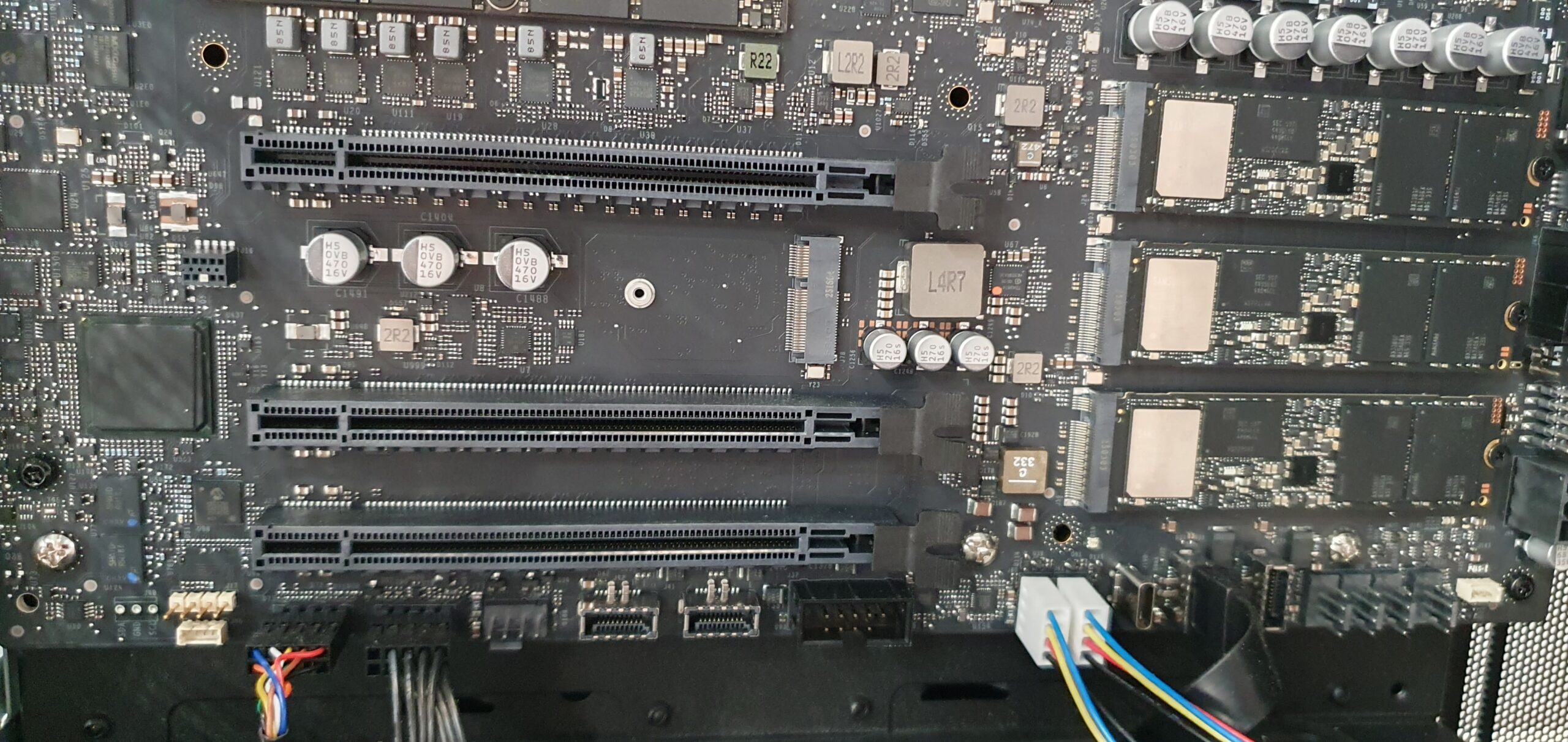
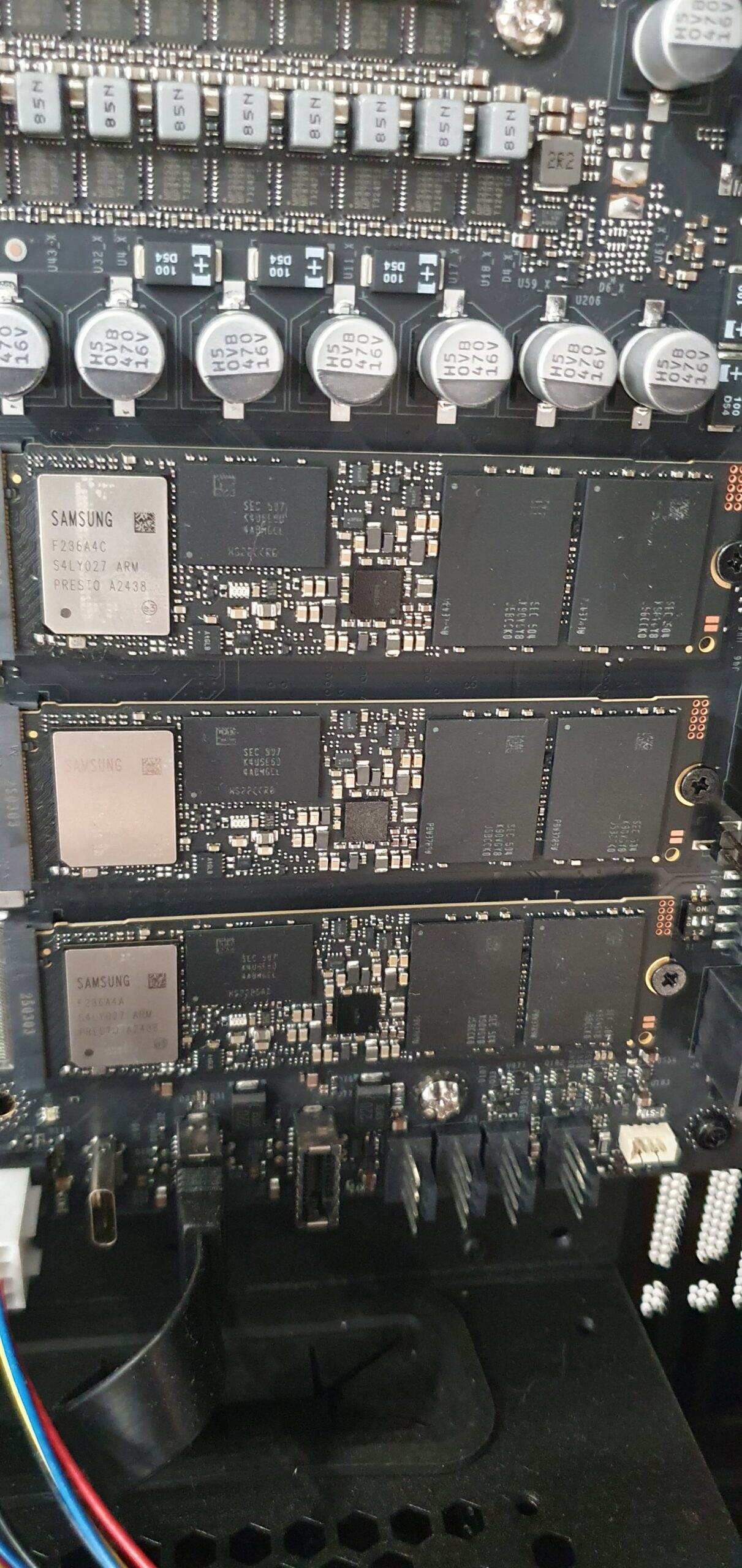
| Storage | 2 × M.2 2280 PCIe Gen6 ×4 (via ConnectX-8) + 2 × M.2 2280 PCIe Gen5 ×4 (via Grace) |
| Management | BMC (P3809) with Mini-DP and dedicated management LAN |
| Security | TPM 2.0, EROT (external root of trust) |
| Wireless | M.2 2230 E-key slot (Wi-Fi / Bluetooth) |
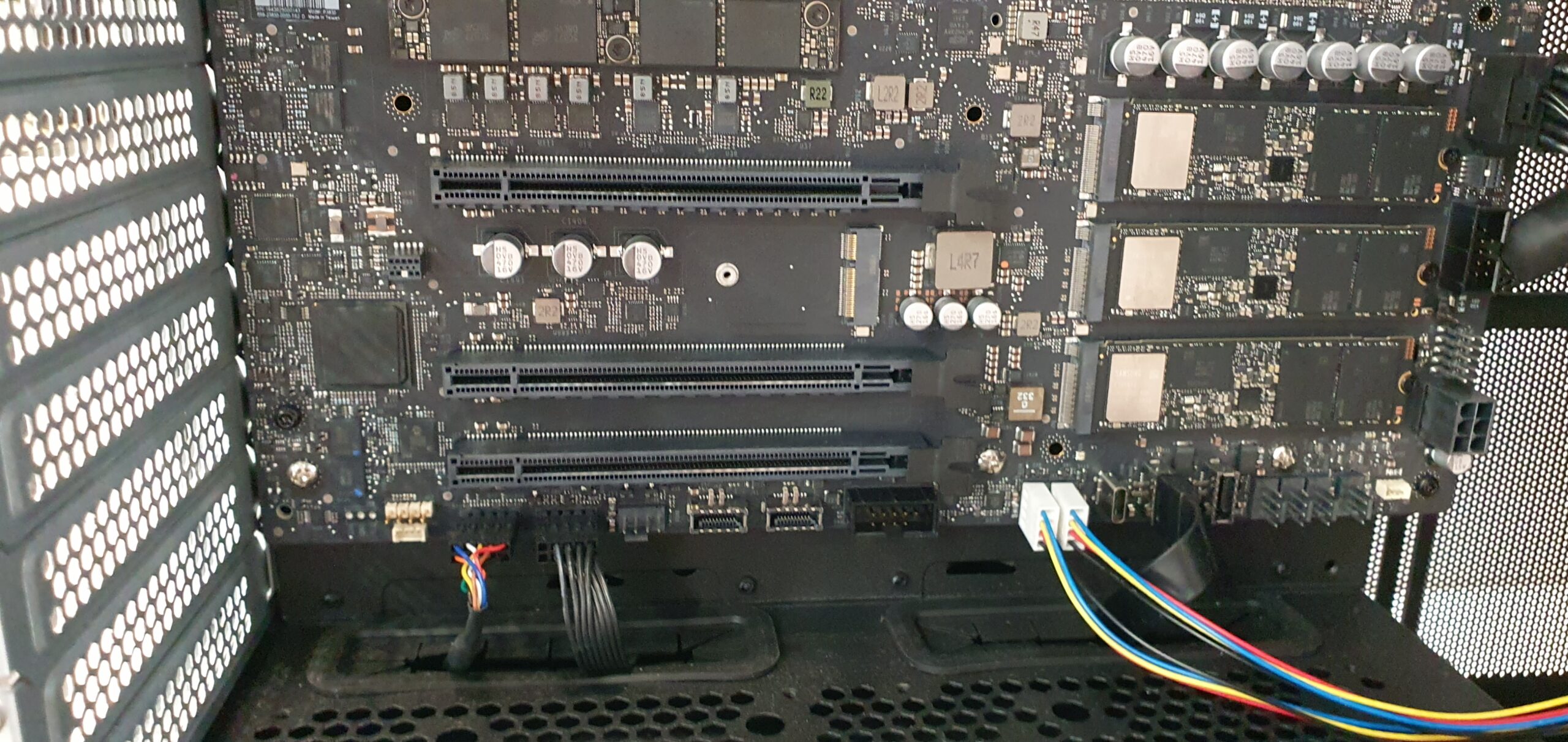
| Expansion | 1 × PCIe x16 slot (Gen5 ×16), 2 × PCIe x16 slots (Gen5 ×8) |
| Power supply | Single 1600 W ATX, 80 PLUS Platinum |
| Cooling | Closed-loop liquid cooling |
What the inside actually looks like
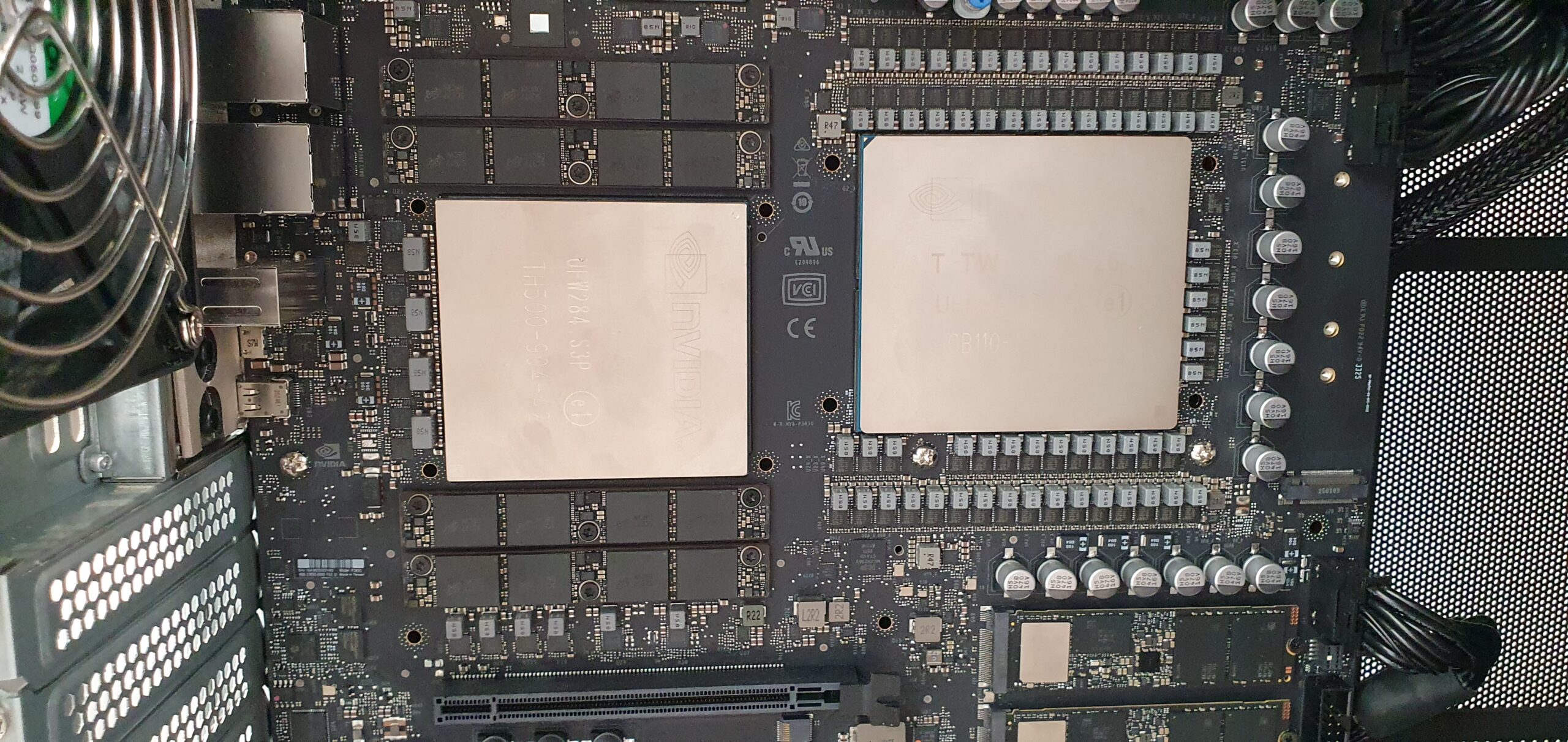
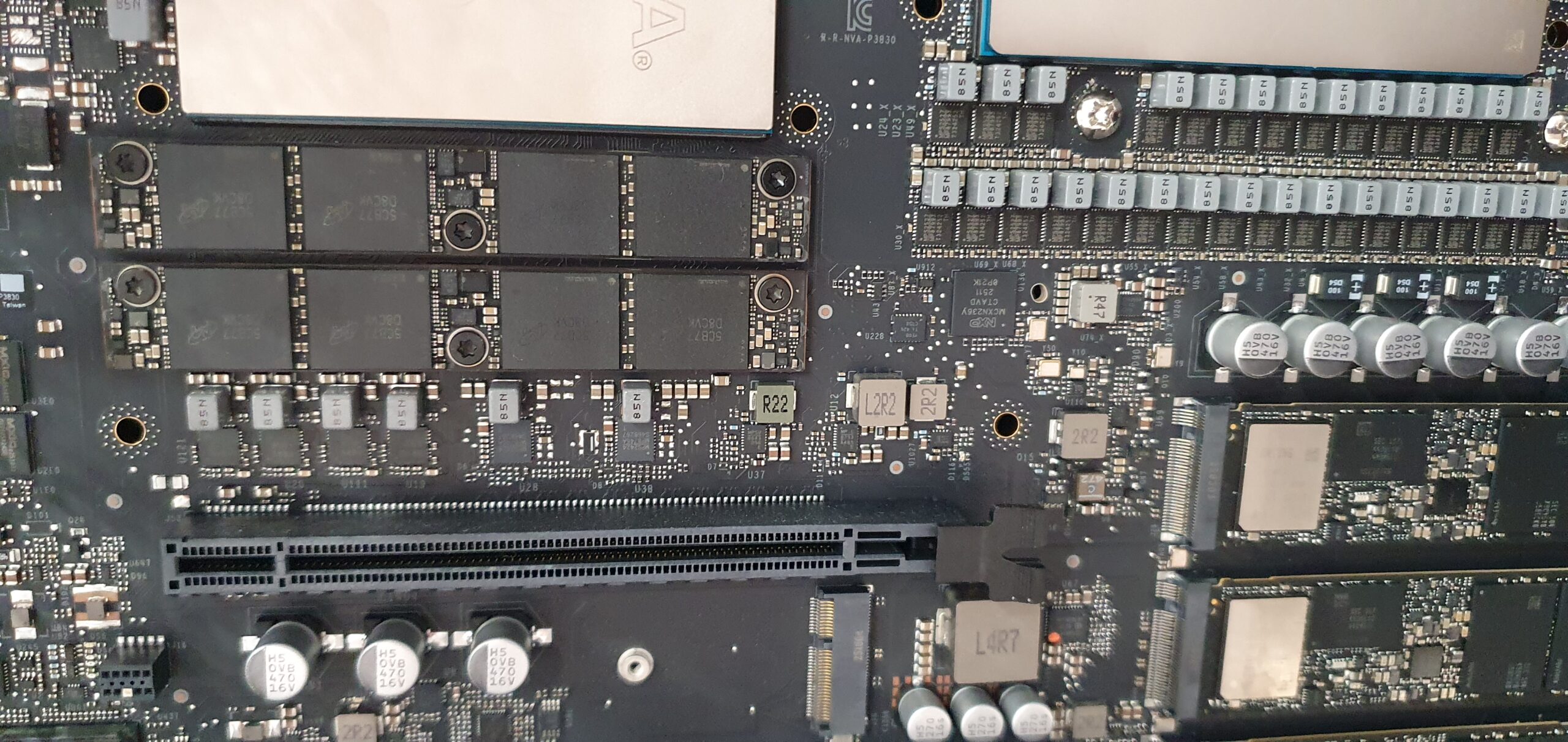
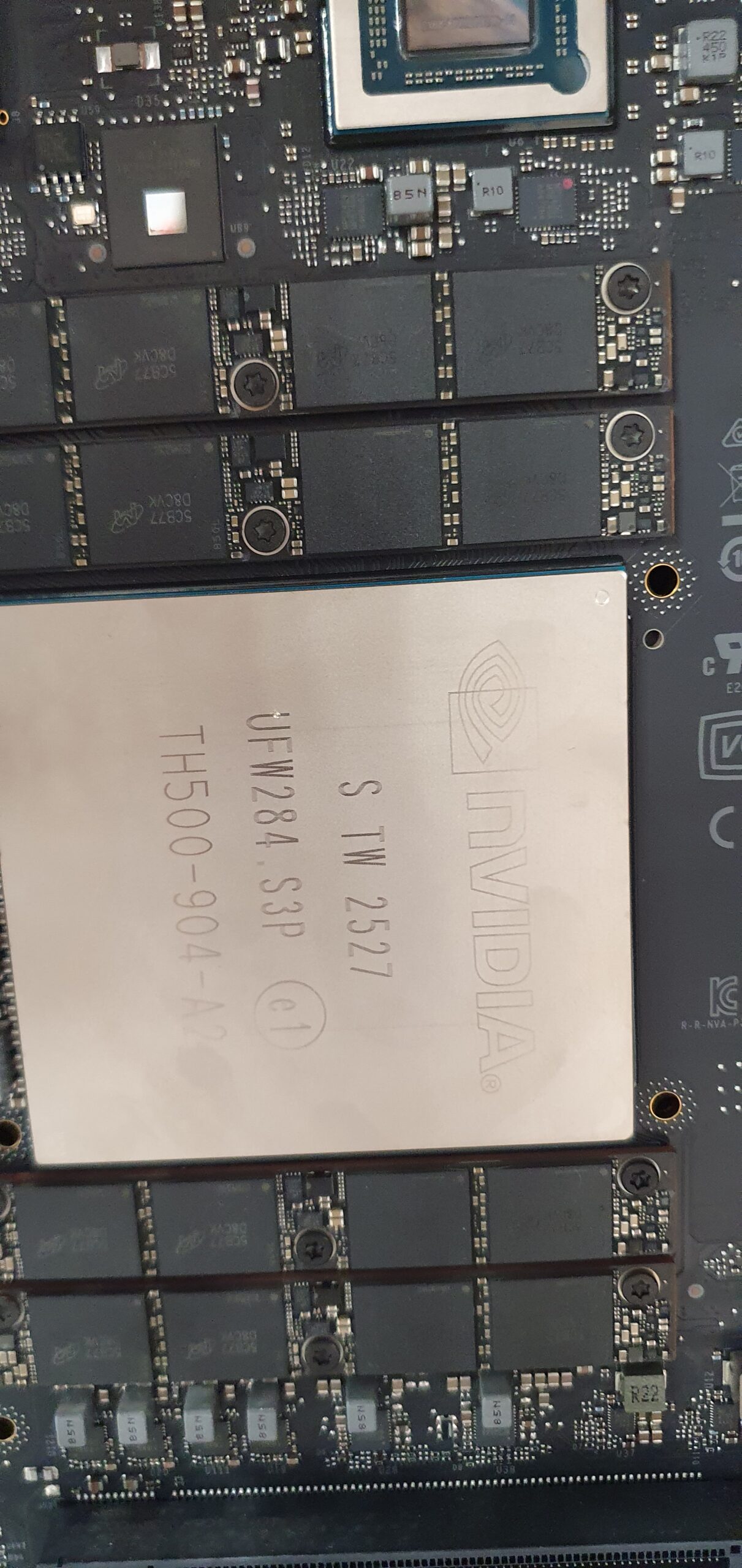
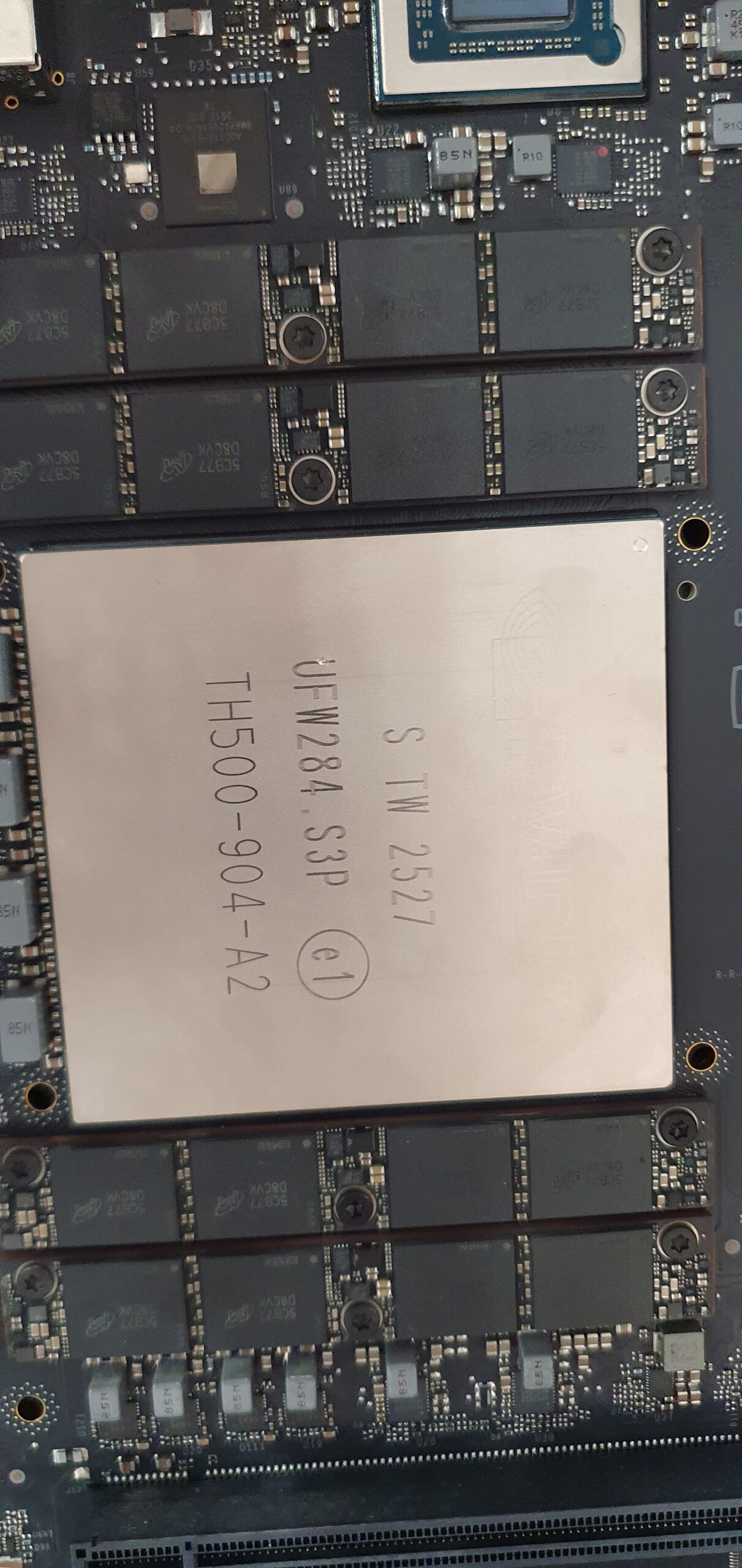
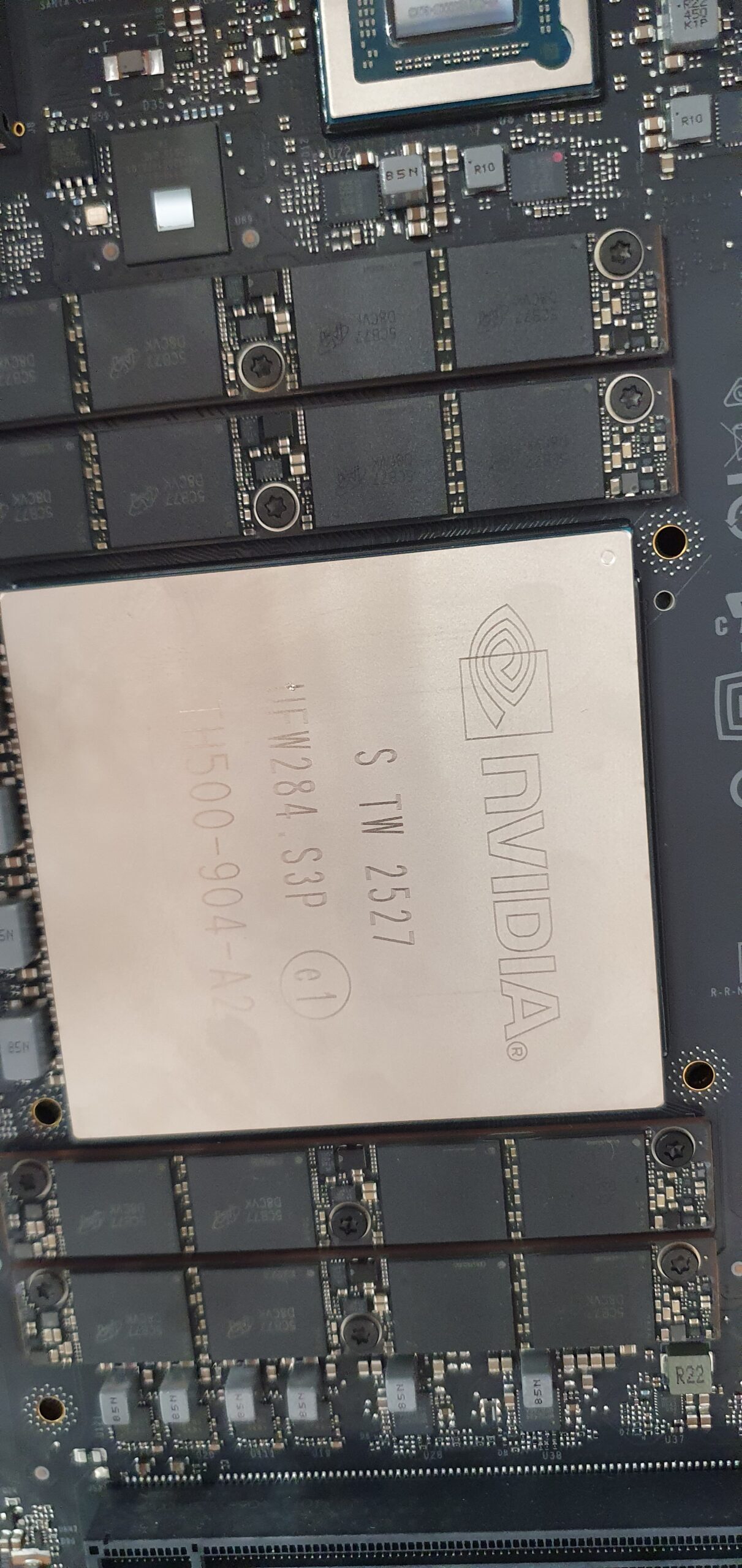
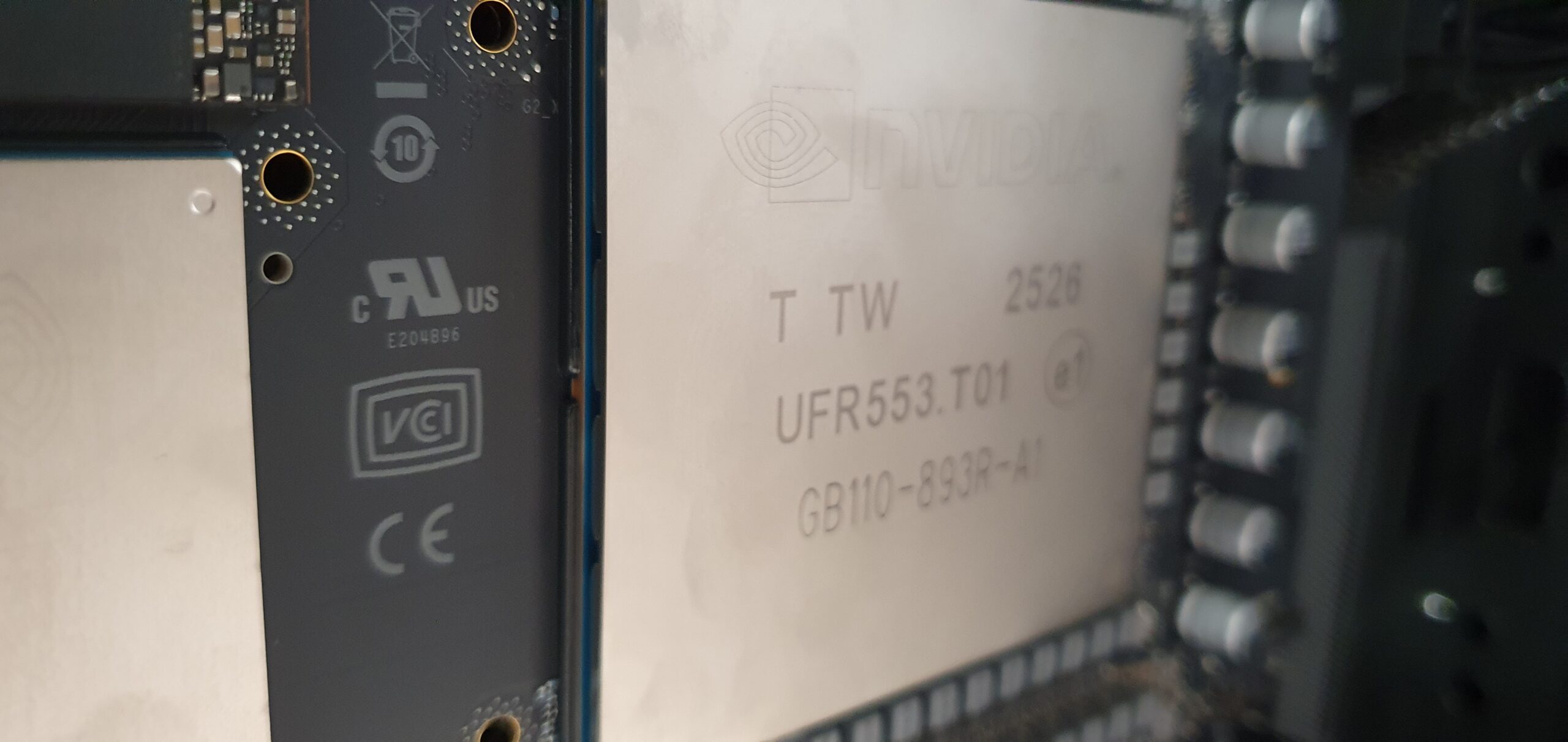
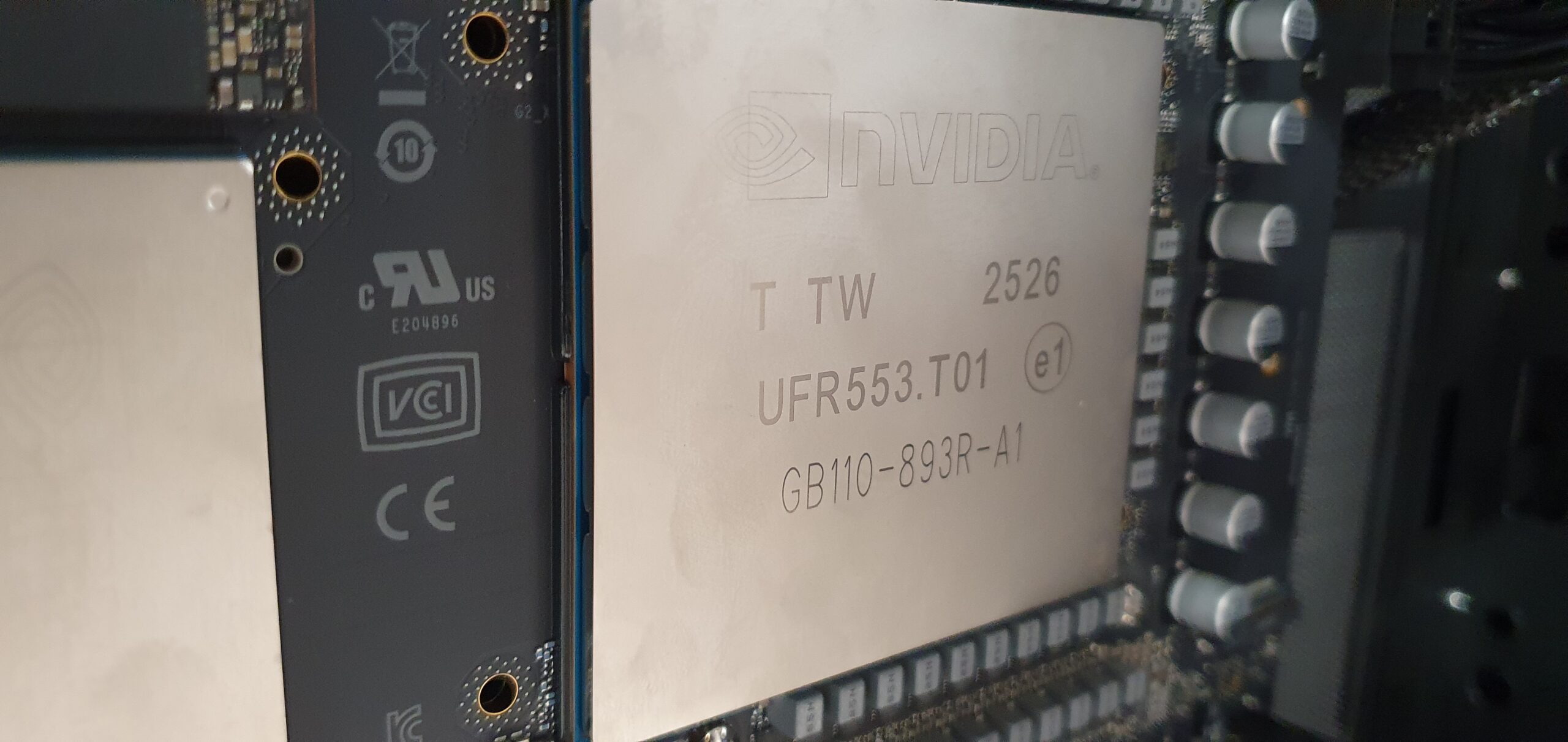
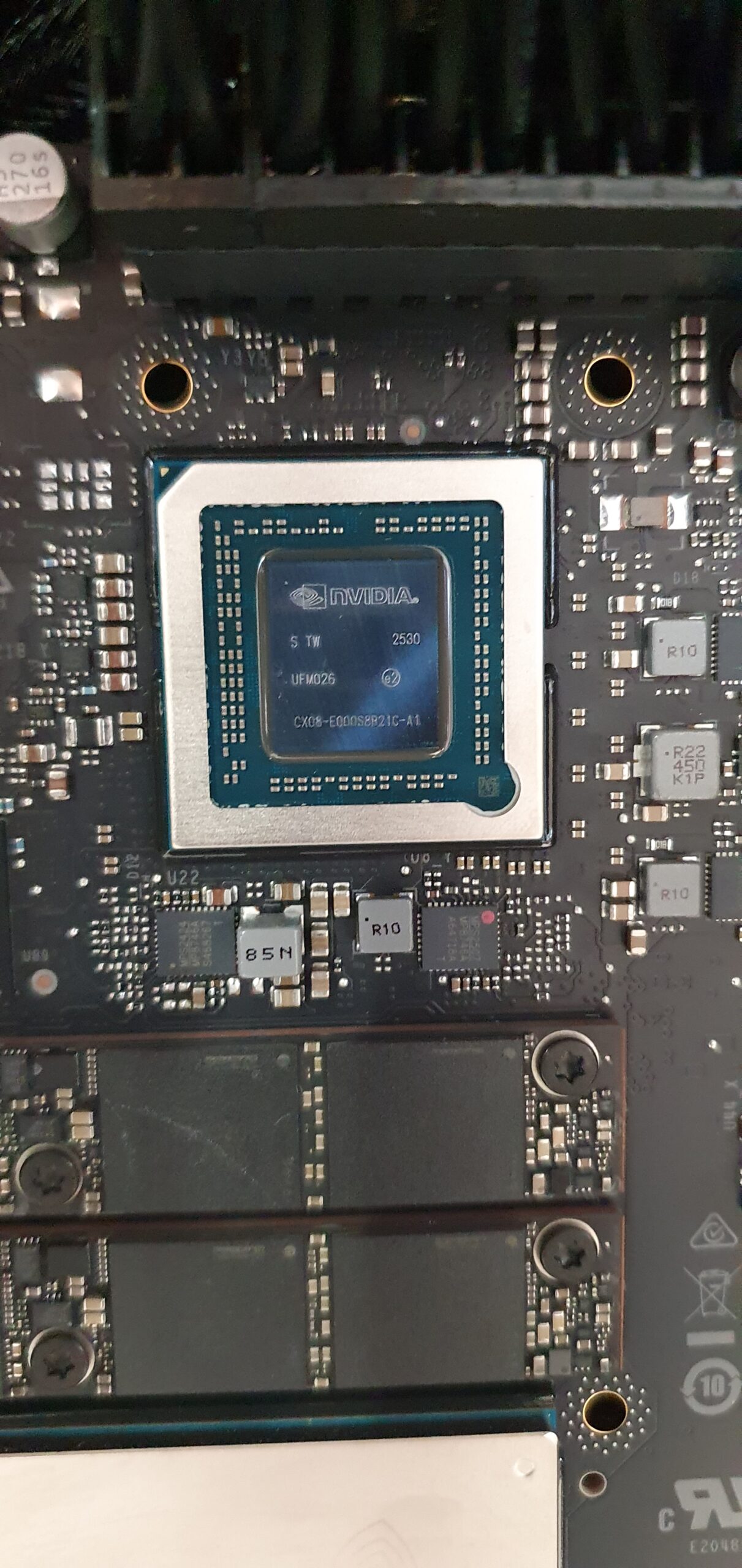
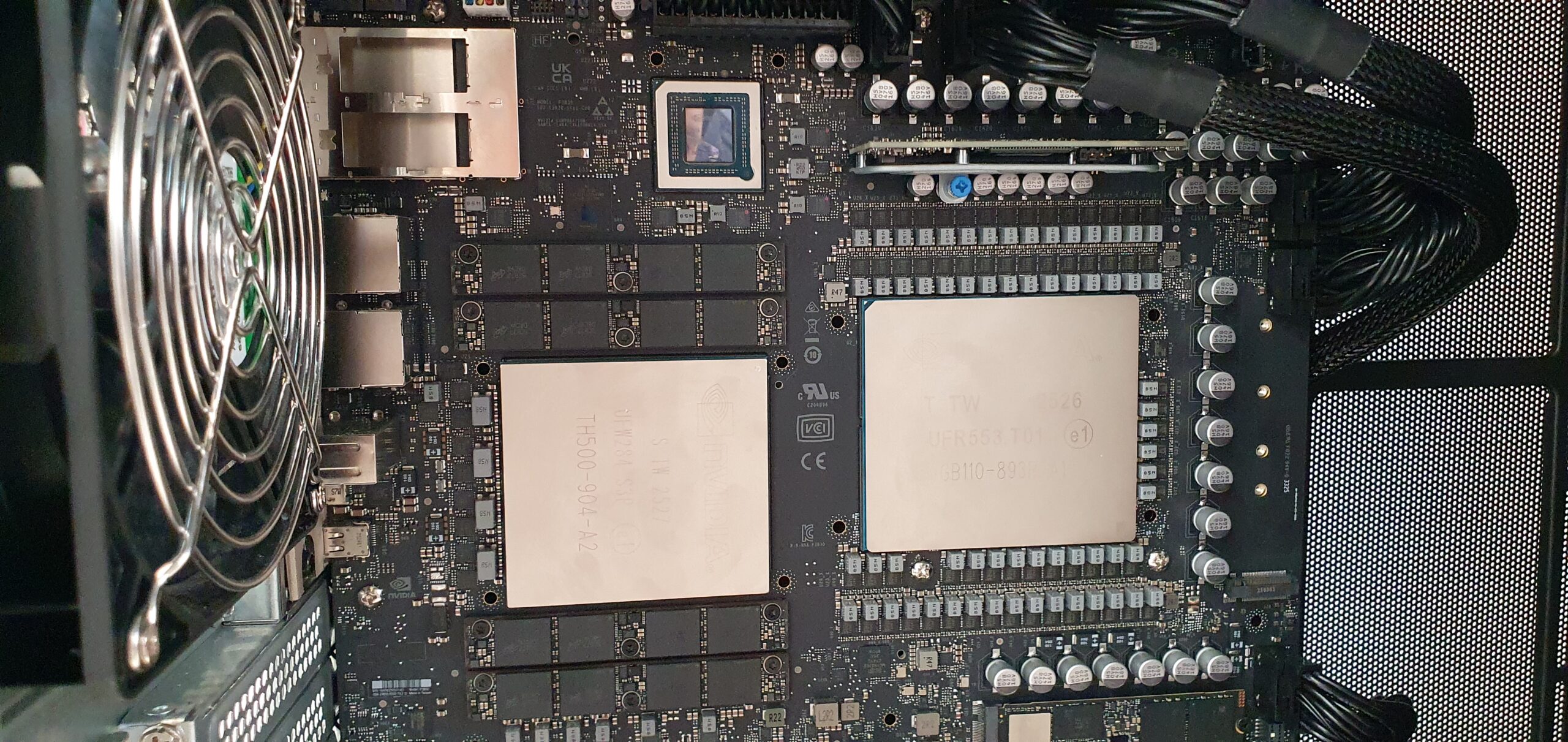
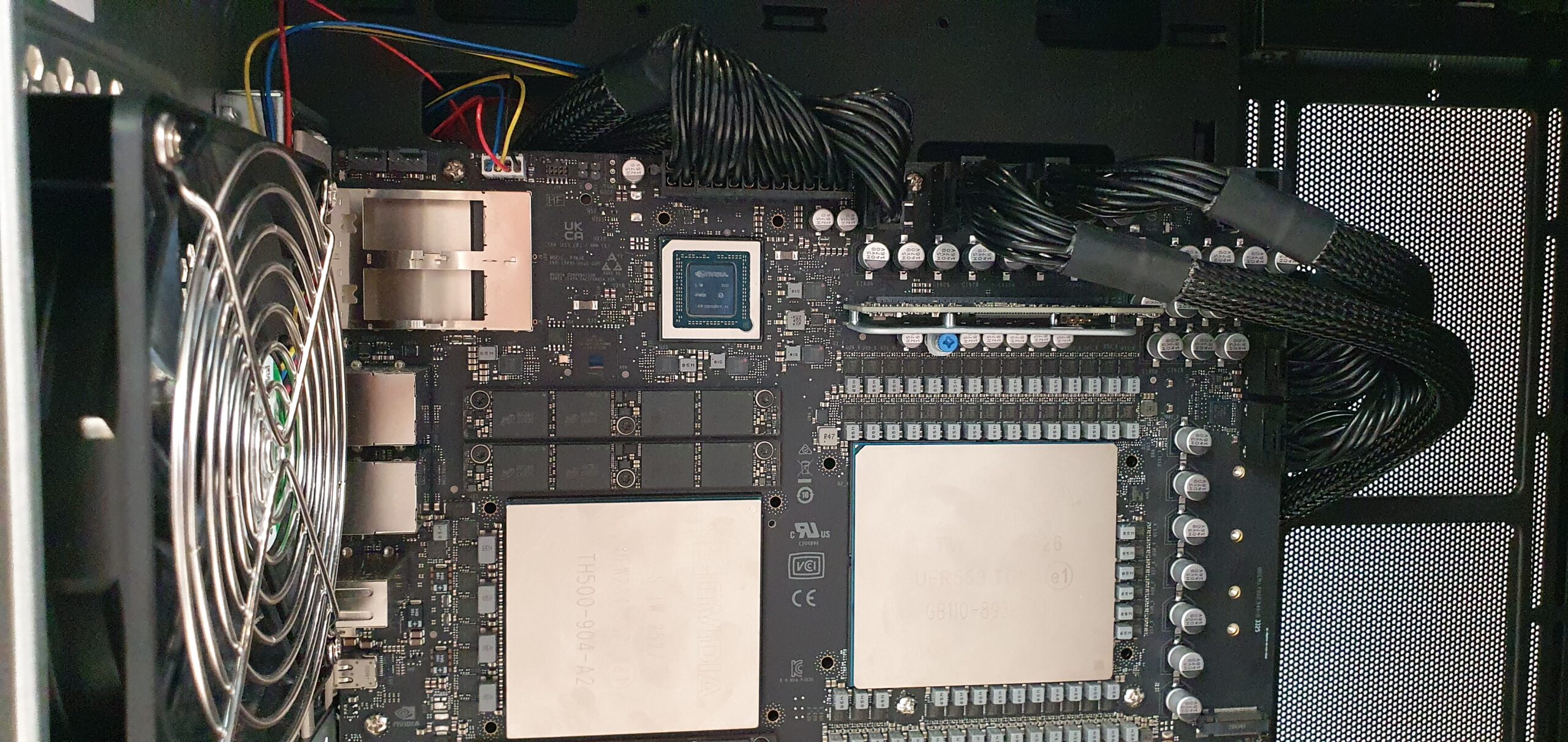
The GB300 superchip dominates the board. In our close-ups the GPU package carries the marking GB110-893R-A1 and the Grace CPU package is stamped TH500-904-A2 – the two dies sitting side by side under separate heat spreaders, ringed by LPDDR5X memory. The ConnectX-8 SuperNIC is a separate package marked CX08-E0005R21C-X4. Storage in the unit we photographed was Samsung M.2 NVMe.
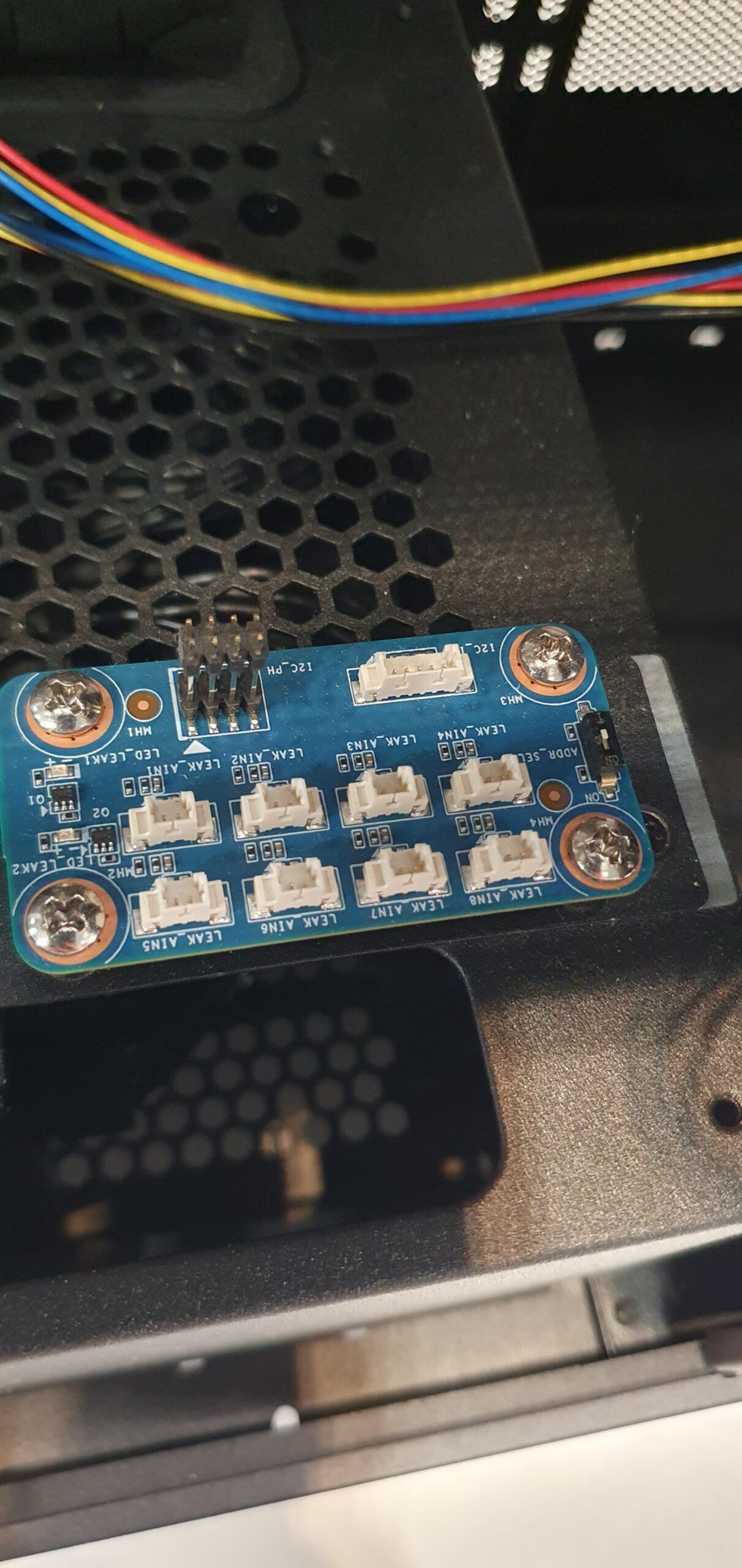
The detail we did not expect was a dedicated leak-detection sensor board. It carries eight discrete sensor inputs labelled LEAK AIN1 through LEAK AIN8, two LED outputs and an I²C interface. For a liquid-cooled machine intended to sit under a desk rather than in a data centre, that is a meaningful engineering decision: eight sensing points is considerably more than a token single-point detector, and it suggests the cooling loop was designed with office deployment in mind.
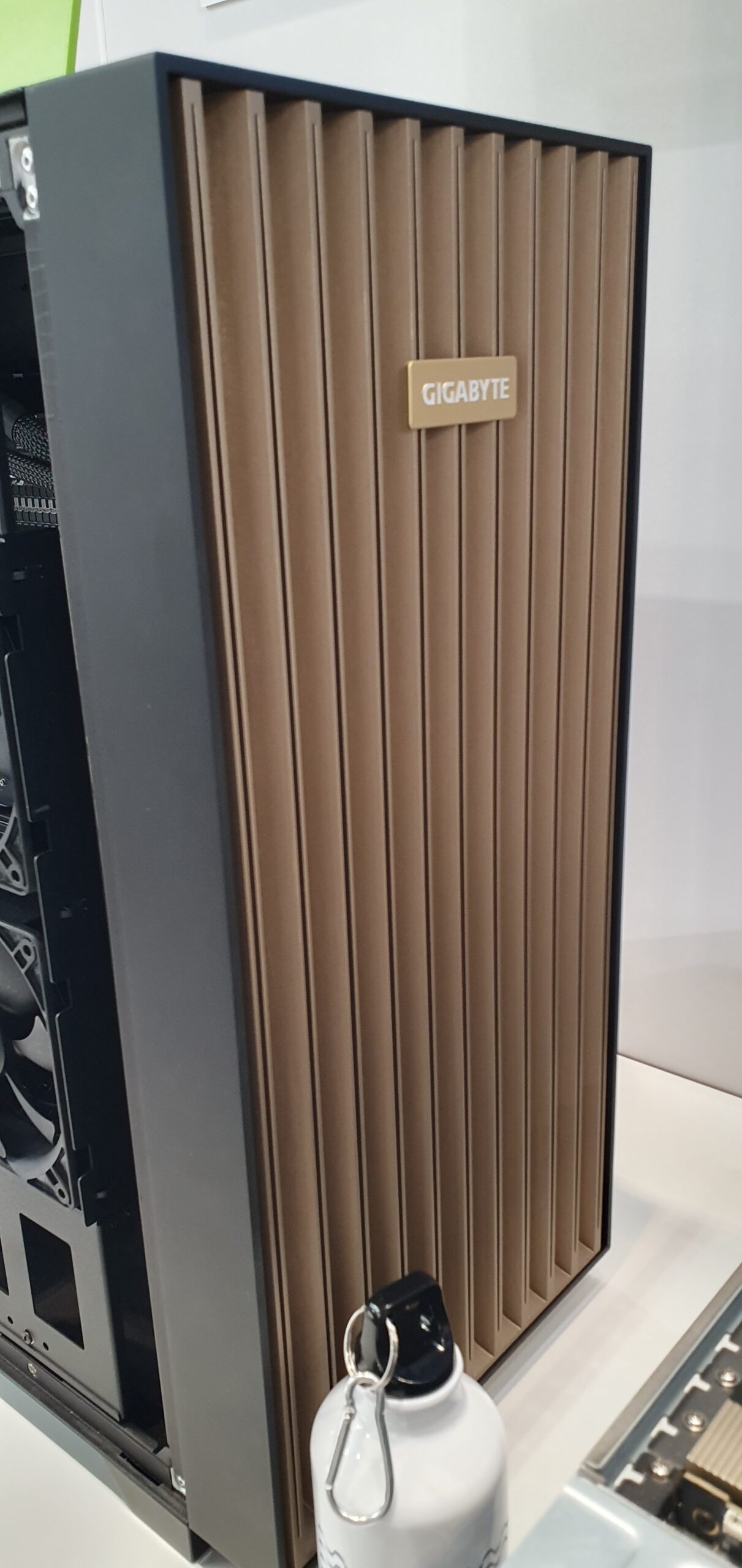
Externally the machine has a gold-toned, ribbed side panel that doubles as the radiator surface.
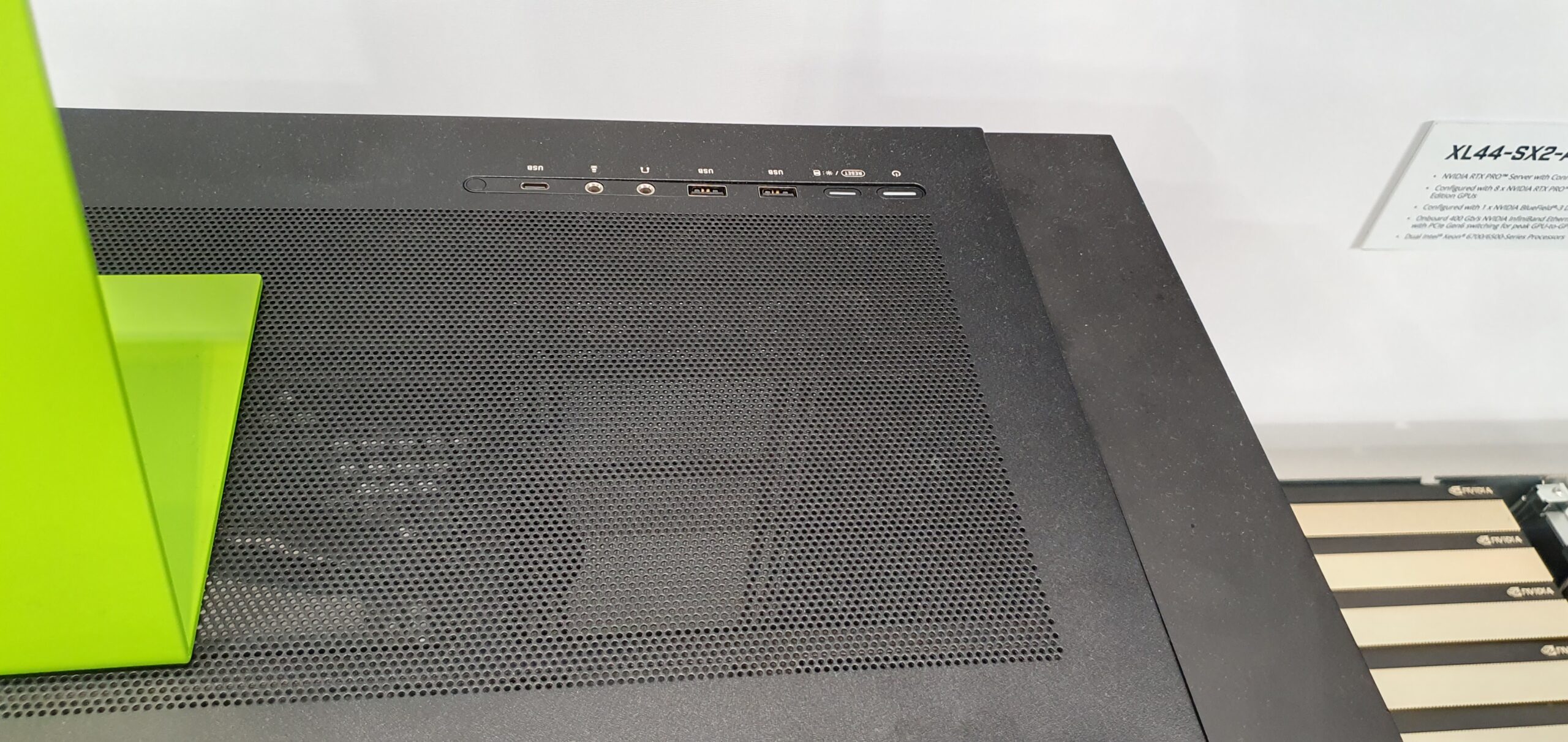
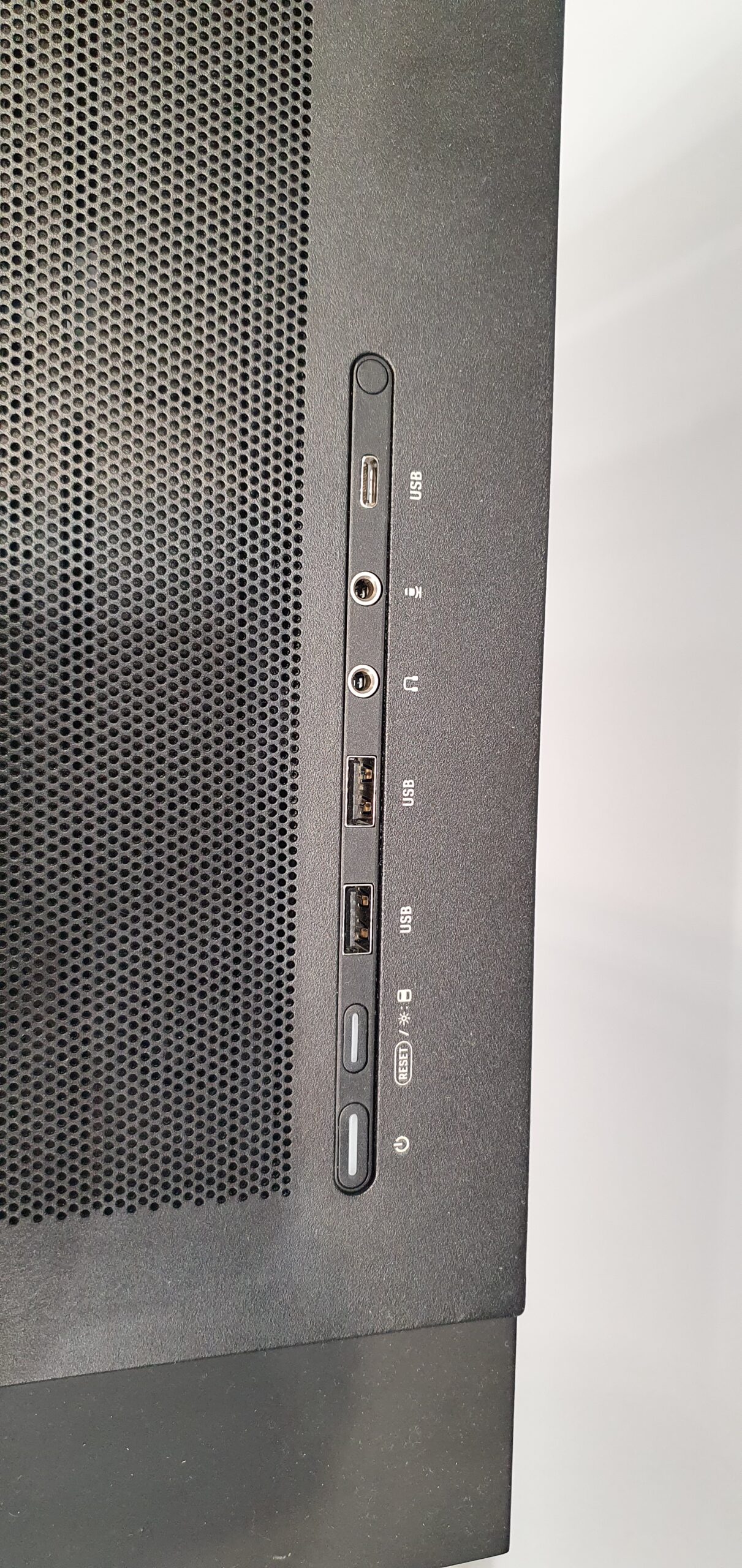
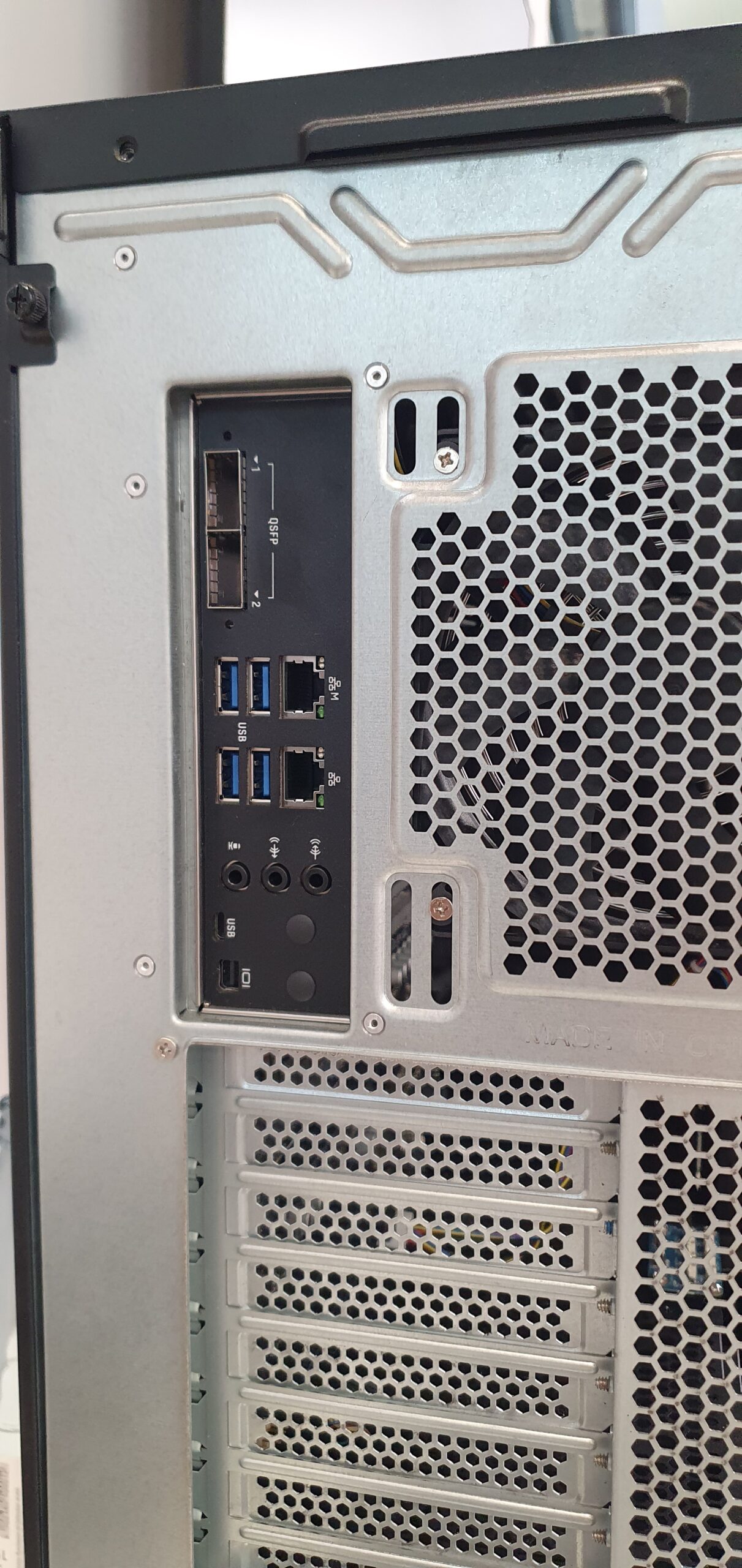
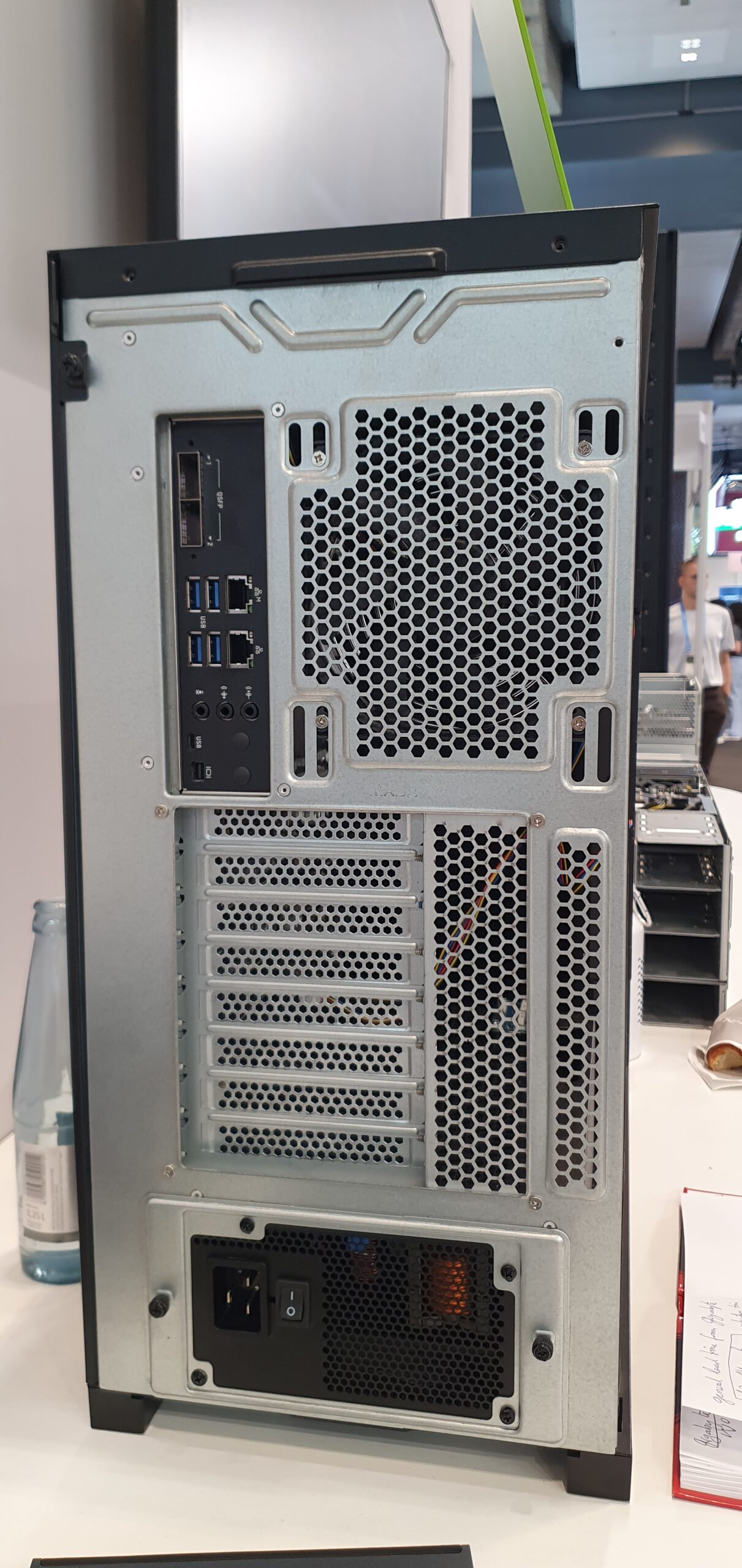
The USB-C, USB-A and audio ports have moved to the top of the system, while the QSFP ports required to interconnect two or more DGX Station workstations sit at the rear, as in every other DGX Station variant.
Gigabyte’s block diagram for the W775-V10-L01
Gigabyte’s own block diagram for the W775-V10-L01 confirms the specification and adds three things worth knowing.
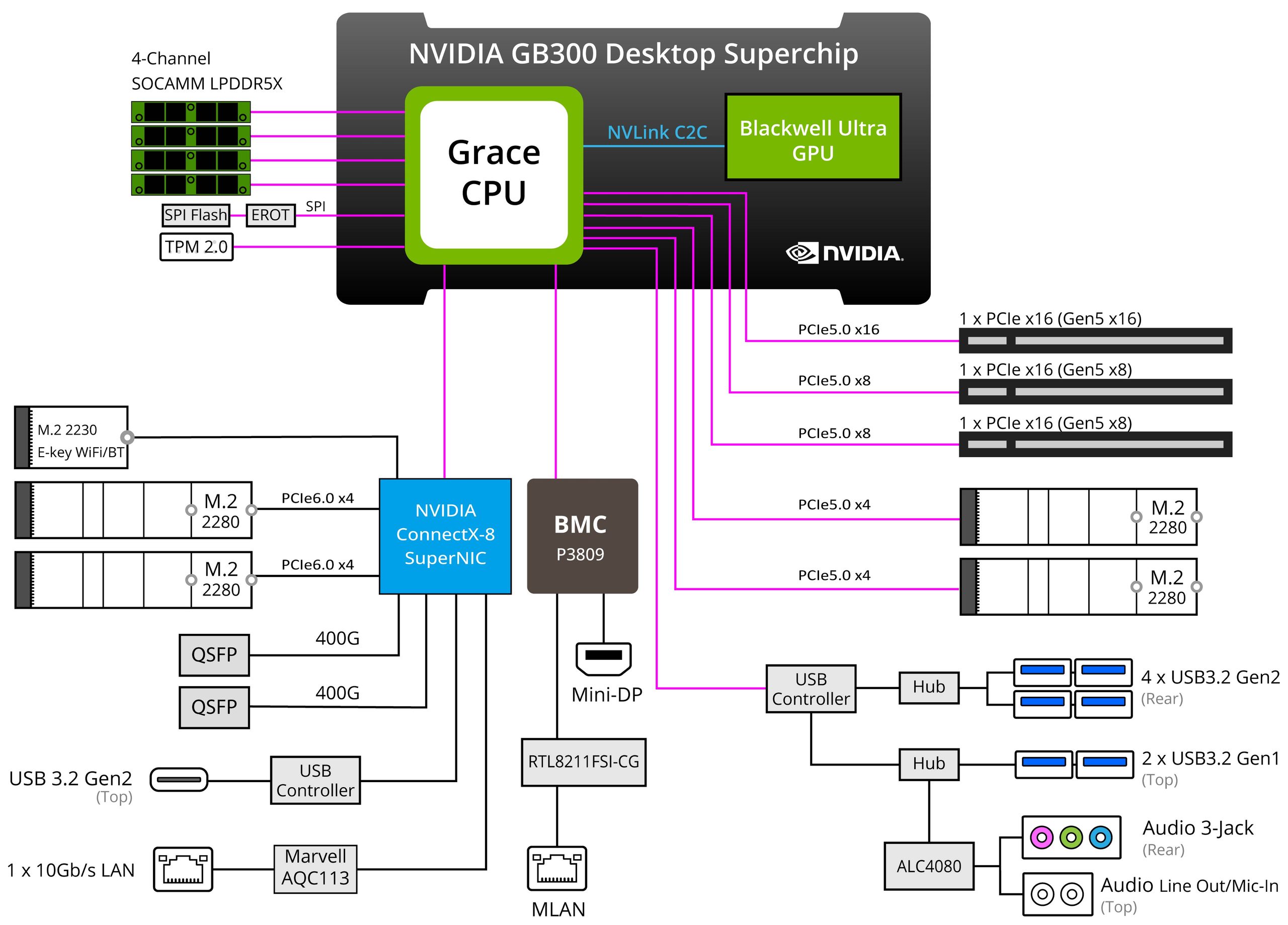
First, the PCIe Gen6 claim is real, and it is more interesting than it looks. The two Gen6 ×4 M.2 2280 slots do not hang off the Grace CPU at all – they are connected through the NVIDIA ConnectX-8 SuperNIC, which is acting as a PCIe switch as well as a network adapter. The other two M.2 2280 slots run PCIe 5.0 ×4 directly from Grace. So the four M.2 slots are not equivalent, and which pair you populate has architectural consequences: storage behind the SuperNIC sits on the same silicon as the 400 GbE ports.
Second, there is a real BMC. The diagram shows a P3809 baseboard management controller with its own Mini-DisplayPort output and a dedicated management LAN via a Realtek RTL8211FSI-CG – separate from the 10 Gb/s Marvell data port. Out-of-band management is a server feature, and its presence on a deskside machine means this can be racked and administered remotely rather than only used as a workstation.
Third, the security hardware. A TPM 2.0 module and an EROT (external root of trust) sit alongside the SPI flash on the Grace CPU’s SPI bus. For customers buying this machine specifically because their data cannot go to a cloud provider, verified boot and a hardware root of trust are usually part of the same compliance conversation.
The diagram also confirms 4-channel SOCAMM LPDDR5X, the three PCIe x16 slots (one Gen5 ×16, two Gen5 ×8), an M.2 2230 E-key slot for Wi-Fi/Bluetooth, and the USB layout: four USB 3.2 Gen2 at the rear, two USB 3.2 Gen1 plus one USB 3.2 Gen2 Type-C on top, with ALC4080 audio.
Gigabyte W775-V10-L01 image gallery
Please note: the liquid cooling assembly has been removed from this system for the trade show (ISC) it was exhibited at. This gives us a unique look at “what is under the hood” – the NVIDIA GB300 chipset.
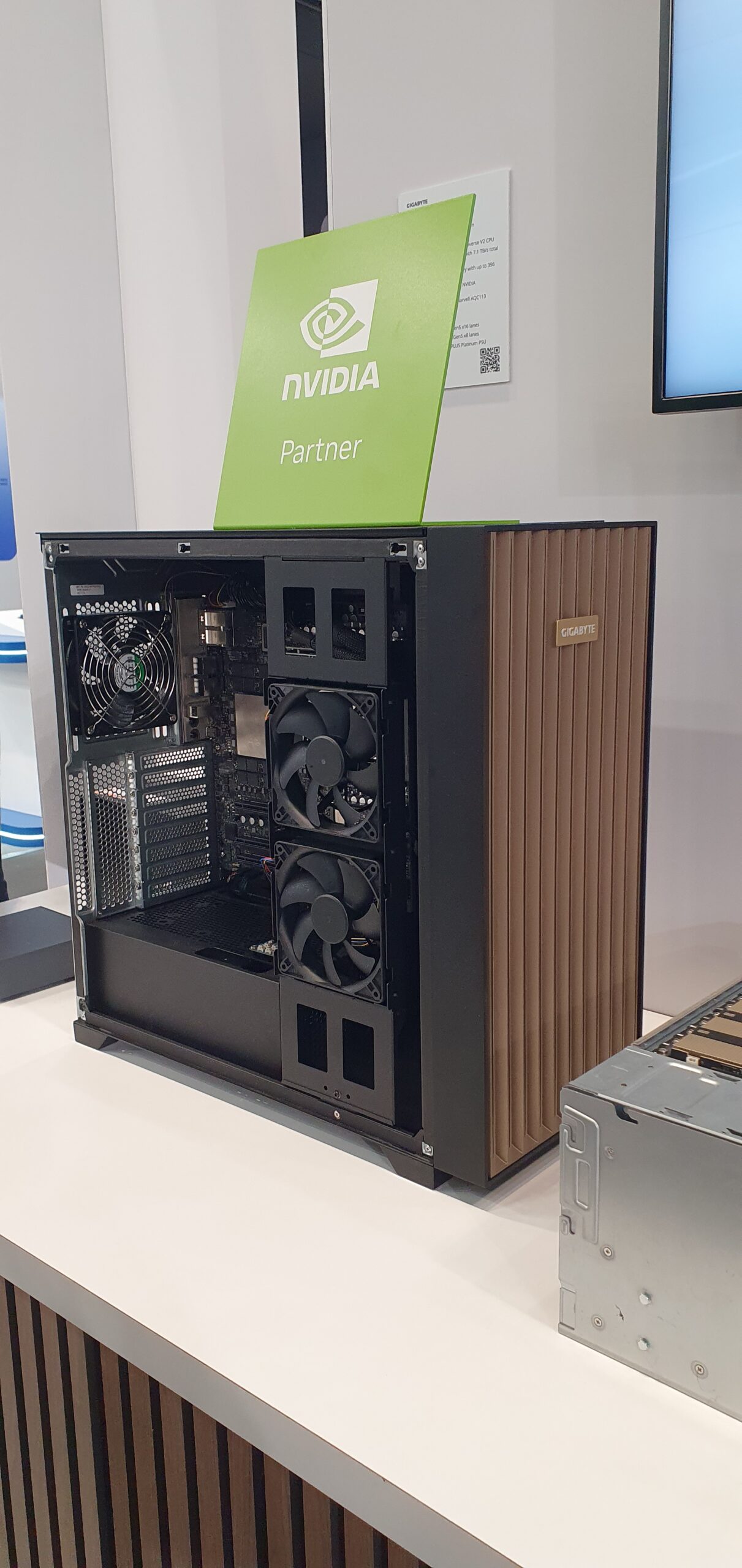
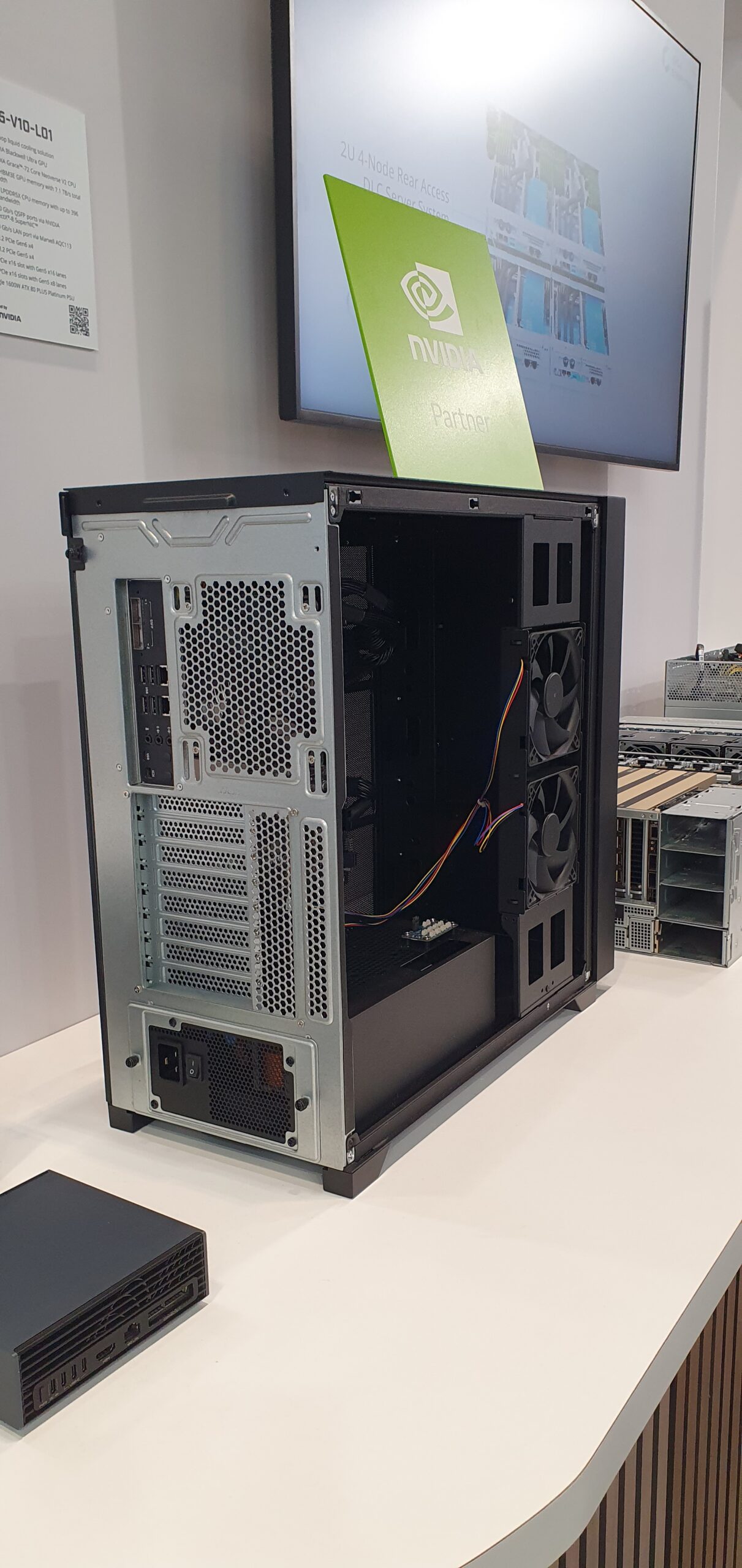
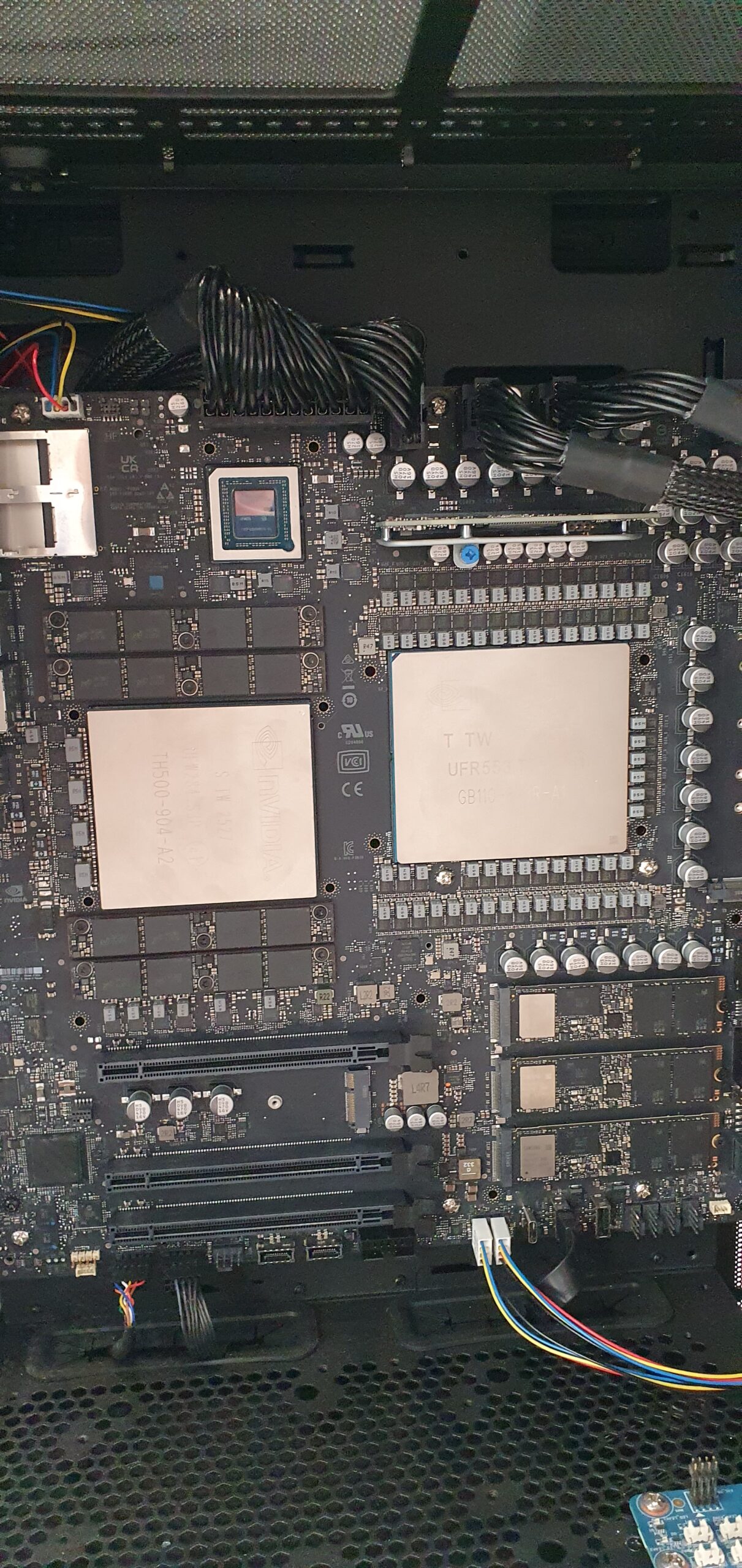
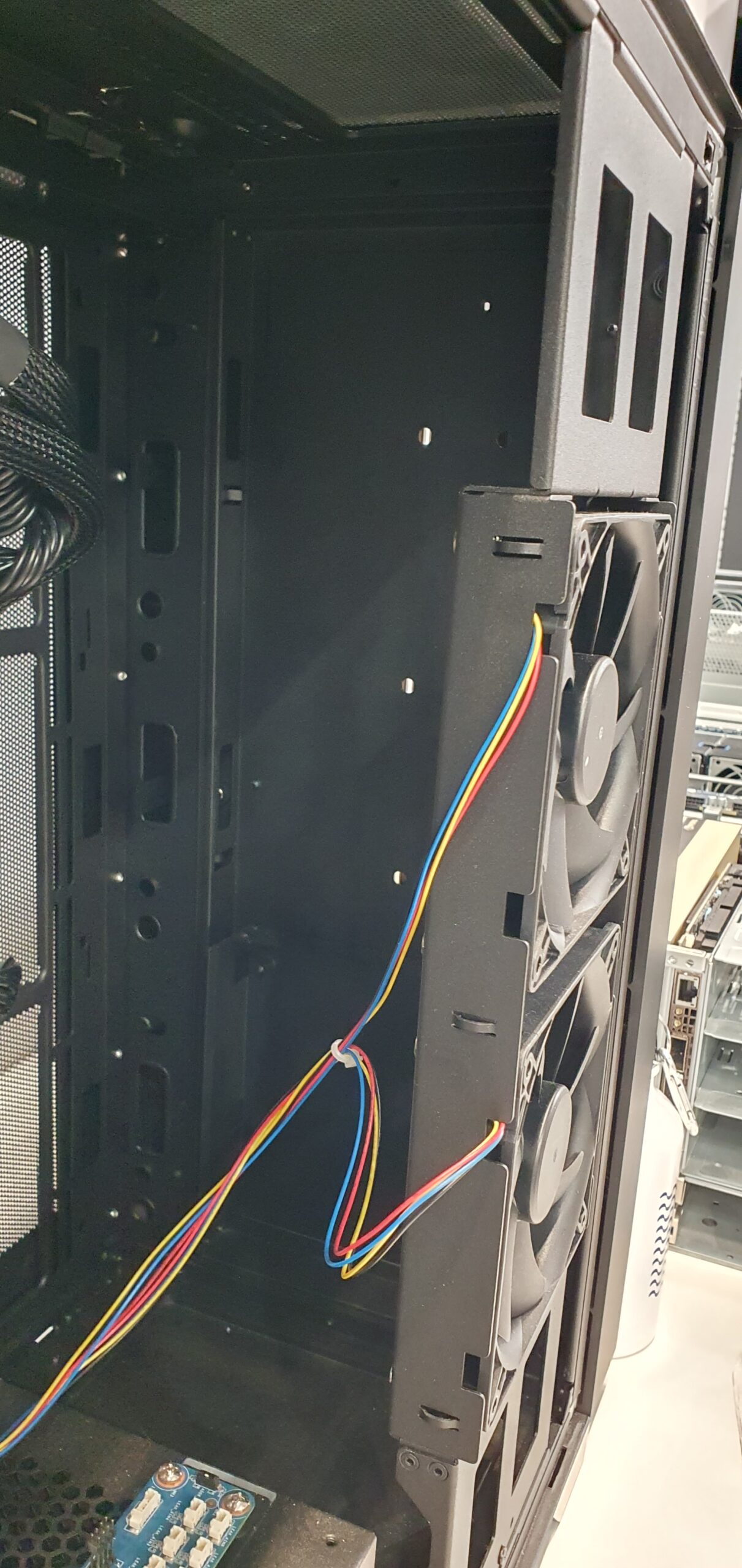
Note: the closed loop liquid cooling system has been removed from this workstation.
How it compares to the Supermicro GB300 station
Both machines are built on the same NVIDIA GB300 reference platform, so the superchip, memory and NVLink-C2C figures are identical. The differences are in what each vendor added around it.
| Gigabyte W775-V10-L01 | Supermicro ARS-511GD-NB-LCC | |
|---|---|---|
| Form factor | Deskside tower | 5U tower |
| M.2 storage | 2 × Gen6 ×4 (via ConnectX-8) + 2 × Gen5 ×4 | 4 × Gen5 ×4 (2280) |
| PCIe expansion | 1 × Gen5 ×16, 2 × Gen5 ×8 | 1 × Gen5 ×16, 2 × Gen5 ×8 |
| Extra LAN | 10 Gb/s Marvell AQC113 | 1x RJ45 10GbE LAN port |
| PSU efficiency | 80 PLUS Platinum | Titanium |
| Liquid cooling | Closed-loop | Closed-loop, user-serviceable |
| Notable detail | 8-point leak detection board | External drain and fill valves |
Gigabyte provides PCIe Gen6 ×4 on two of its four M.2 slots – ahead of the Gen5 in NVIDIA’s reference specification, and confirmed by Gigabyte’s own block diagram above.
Against that, Supermicro’s Titanium-grade power supply is a genuine operational advantage in an always-on machine, and its externally accessible coolant drain makes long-term maintenance simpler. We photographed that system too – see our Supermicro ARS-511GD-NB-LCC teardown.
Who this machine is for
748 GB of coherent memory is the point. It lets you hold models in one address space that would otherwise need to be sharded across several discrete GPUs, without the engineering effort that sharding costs. In practice that suits teams fine-tuning large open-weight models, running long-context inference, or doing scientific work where the working set genuinely does not fit in the 80 GB of an H100 or the 141 GB of an H200.
The other reason customers come to us for these is cloud independence: regulated data that cannot leave the building, or a workload steady enough that renting stops making financial sense. If you are weighing this against a multi-GPU server, our DGX Station GB300 versus 4× / 8× RTX PRO 6000 comparison works through that trade-off, and our GB300 specifications and LLM benchmarks covers the performance figures in detail.
Buying one
pi3g supplies the NVIDIA DGX Station GB300 in Germany and across Europe, including the Gigabyte W775-V10-L01. We can advise on which vendor implementation fits your environment, and on lead times, which move around.
- Startups may qualify for a discount through NVIDIA Inception.
- Universities and research institutes should look at the NVIDIA EDU discount.
- See the full DGX Station availability and ordering page.
All photographs on this page were taken by pi3g at ISC 2026. Specifications are transcribed from the manufacturer’s booth placard and NVIDIA’s published specification; final shipping configurations may differ.
 English
  Deutsch (Sie)